Customer Risk Rating: Factors, Methods, and Models for AML Compliance

Customer risk rating scores how likely a customer is to be involved in money laundering, terrorist financing, or other financial crime, then uses that score to decide how much due diligence and monitoring the relationship needs. The practice sits at the center of the risk-based approach that FATF, the EU Anti-Money Laundering Directives, and FinCEN all expect regulated firms to operate. A defensible rating combines customer attributes, geography, product and channel risk, and behavioral signals into one tier. That tier drives onboarding decisions and the cadence of ongoing review.
For compliance teams, the rating is not a one-time label. It lives. When transactions, ownership, sanctions exposure, or adverse media shift, the score needs to shift too. This guide covers the factors that feed a customer risk rating, the methods and models firms use to calculate it, and how the resulting tiers map to enhanced due diligence and re-KYC.
What Is Customer Risk Rating?
Customer risk rating assesses the money laundering and financial crime risk tied to each customer or entity, then assigns a category that sets the depth of due diligence. Get it right and an institution has a structured way to spot higher-risk relationships, steer compliance resources toward the areas of greatest exposure, and show regulators and auditors that its program really is risk-based.
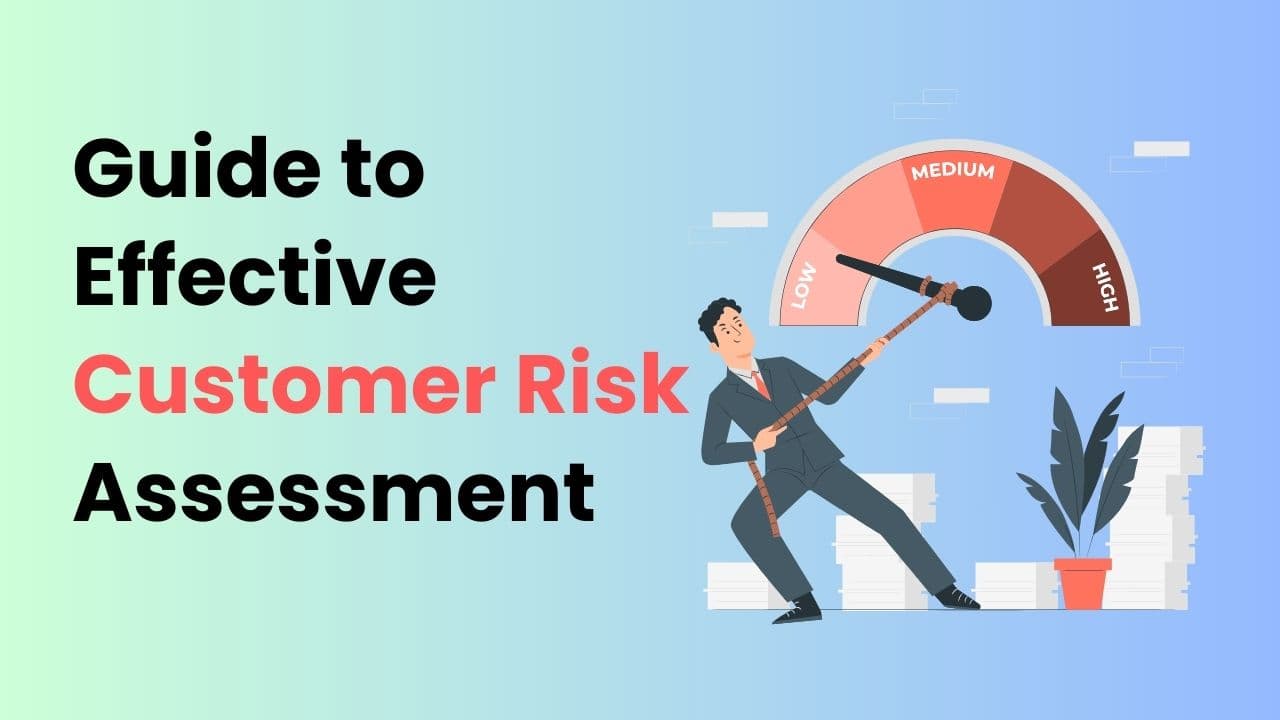
The output is usually a tier, low, medium, or high, backed by a numeric score. It is what a firm points to when it has to explain why one customer cleared standard onboarding while another got routed to enhanced due diligence. Skip the consistent model and treatment turns ad hoc. Worse, the institution loses the audit trail that examiners look for when they test the risk-based approach.
Customer Risk Rating Factors
Several factors feed a customer's risk score. Weighting them consistently is what separates a defensible model from a subjective judgment call. The common inputs below align with FATF guidance on the risk-based approach.
Customer and Entity Attributes
Who the customer is drives much of the score. Relevant attributes include legal structure, beneficial ownership complexity, the customer's industry, and whether the customer or any owner is a politically exposed person. Opaque ownership chains and nominee arrangements push the score up. They obscure who ultimately controls and benefits from the relationship.
Geographic Factors
Jurisdiction risk reflects exposure to weak AML oversight, sanctions, high corruption, or terrorist financing. Country of incorporation, country of residence, and the geographies a customer transacts with all matter. Anchor geographic scoring to recognized sources, such as FATF grey and black lists, sanctions regimes, and corruption indices, rather than informal judgment.
Product, Channel, and Transaction Risk
The products a customer uses and how they were onboarded shape inherent risk. Cash-intensive products, correspondent banking, trade finance, and non-face-to-face or fully remote onboarding all carry more of it. Behavior feeds the picture too. Unusual volumes, rapid movement of funds, or activity that does not match the stated profile push a rating upward. Transaction monitoring supplies the behavioral signal that keeps a rating current rather than frozen at onboarding.
Source of Wealth and Source of Funds
Where the money comes from is central to AML risk. Unverifiable or implausible source of wealth, or funds that do not match the customer's profile, are strong risk indicators. They are often the trigger for enhanced scrutiny.
Politically Exposed Persons and Sanctions Exposure
Politically exposed persons, their close associates, and any sanctions or adverse media linkage materially raise a rating, given the elevated potential for corruption and abuse of position. Continuous screening against sanctions, PEP, and adverse media data keeps this factor live across the lifecycle of the relationship.
Customer Risk Assessment: From Factors to a Score
Customer risk assessment combines the factors above into one defensible score and tier. Most programs split inherent risk, the exposure before any controls, from residual risk, what remains after mitigating controls are applied. A model that records both makes it far easier to explain to an examiner why a high inherent-risk customer is still acceptable to bank.
A workable assessment assigns weights to each factor, writes down the rationale for those weights, and produces a tier with a clear audit trail. Weighting should reflect the institution's own risk appetite and the products it offers, not a generic template applied without adjustment. Pre-defined assessment templates speed this up. Calibrate them to the firm rather than adopt them verbatim.
Risk Rating in Banking
In banking, customer risk rating underpins risk-based customer due diligence across retail, commercial, and correspondent relationships. Examiners expect a bank to show that its rating methodology is documented, applied consistently, and refreshed on a defined cadence. The Basel Committee's principles on risk data aggregation, often referenced as BCBS 239, stress that banks should be able to aggregate risk exposures accurately and quickly across the group. That depends on clean, consistent customer risk data feeding the rating model.
Banks also have to reconcile customer risk rating with related but distinct measures. Credit risk rating estimates the likelihood a borrower defaults on an obligation. AML customer risk rating estimates the likelihood a customer is used for financial crime. Different inputs, different control objectives. Conflating the two is a common audit finding.
High-Risk Customer KYC
High-risk customers are the ones a rating model flags for elevated financial crime exposure: PEPs, customers in cash-intensive or higher-risk sectors, complex offshore structures, or relationships tied to high-risk jurisdictions. Once a customer lands in the high tier, the program should route them to enhanced due diligence automatically. Relying on an analyst to remember to escalate is how cases slip.
Enhanced due diligence here usually means deeper beneficial ownership verification, corroborated source of wealth, senior management sign-off on the relationship, and tighter ongoing transaction monitoring. The rating is the trigger. A program's strength shows in whether the right customers actually get that heightened treatment in practice.
Re-KYC of High-Risk Customers
Risk does not stay still, so ratings have to be reviewed. High-risk customers face the most frequent re-KYC, on a shorter periodic cycle than lower-risk tiers. Event-driven reviews sit on top of that, triggered by changes such as new adverse media, a sanctions hit, a shift in beneficial ownership, or a swing in transaction behavior. A perpetual KYC model swaps purely calendar-based reviews for continuous monitoring that re-rates a customer the moment a material signal changes. The payoff is fewer stale ratings and fewer unnecessary full refreshes.
Customer Risk Profiling in AML
Customer risk profiling is the broader practice of building and maintaining a full picture of a customer's financial crime risk. The rating is the summary output of that picture. A profile pulls together identity and verification data, beneficial ownership, screening results, expected activity, and observed behavior, then keeps it current. Network risk matters more every year. A customer who looks clean in isolation may share addresses, devices, counterparties, or ownership links with known bad actors. Profiling that surfaces those connections catches risk that single-customer scoring misses.
Methods and Models for Customer Risk Rating
There is no single way to calculate a rating. Firms pick from a range of approaches, and plenty blend more than one.
Rule-based models apply pre-defined rules and thresholds to assign a score. Transparent and easy to explain, which examiners value. They can also miss complex or novel risk patterns, and they need manual tuning as typologies evolve. Weighted scorecards extend the idea by assigning relative weights to each factor and summing them into a tier, adding nuance while staying explainable.
Advanced analytics and machine learning models sift larger data volumes to catch subtle patterns, outliers, and network connections that static rules miss, and they adapt as new signals emerge. The trade-off is explainability and governance. Any model that drives regulatory decisions has to be documented, validated, and defensible. That is why many firms lean on machine learning to back up expert judgment and surface emerging risk, rather than letting it replace a transparent scoring layer outright. In practice the pattern is hybrid: rule-based or scorecard logic for the defensible core, analytics layered on for continuous monitoring and network detection.
KYC Hub's Customer Risk Rating Solution
KYC Hub provides a customer risk rating solution for compliance teams that need rigor and configurability in equal measure. Configure risk scoring against your own factors and weights, start from pre-defined risk assessment templates, and back expert judgment with AI rather than handing decisions to a black box.
Risk scores update as transactions, screening results, and external signals change, so ratings reflect current exposure instead of onboarding-day assumptions. Network risk detection surfaces hidden connections between customers, counterparties, and beneficial owners. Because the solution integrates with screening, monitoring, and case management, a rating change can trigger the right downstream review automatically.