Self-Sovereign Identity: A Guide for Compliance and Identity Teams
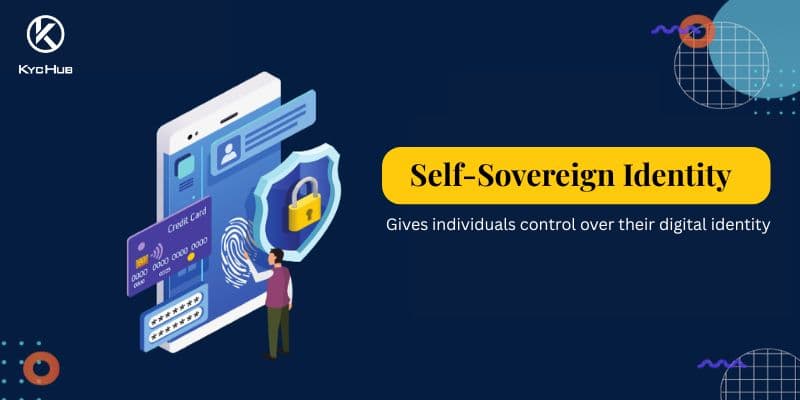
Self-sovereign identity (SSI) is a digital identity model in which individuals hold and control their own credentials rather than depending on a central authority to store and release them. Rather than every organization holding its own copy of a customer record, the customer carries cryptographically signed credentials in a digital wallet and shares only the specific attributes a verifier asks for. For compliance teams, the appeal is concrete: one identity proof can be reused, presented the same way each time, and verified without the firm having to re-collect and warehouse sensitive data on every interaction.
What does this look like in practice? Below, we walk through how decentralized identifiers and verifiable credentials fit together, and where SSI runs into KYC and AML obligations. It is written for compliance leaders, onboarding teams, and risk practitioners who are weighing whether portable, reusable identity belongs on their roadmap.
What Is Self-Sovereign Identity?
Self-sovereign identity is an approach where the individual is the holder and controller of their own identity data. No bank, government, or platform acts as the single custodian of a person's records. Instead, the person keeps verifiable credentials in a wallet and decides which attributes to disclose, to whom, and for how long.
The contrast with conventional identity systems is the whole point. In the traditional model, institutions hold the control: a firm collects identity data, stores it in its own systems, then re-verifies the same person at the next interaction or with the next provider. SSI flips that arrangement. The credential now sits with the individual, signed by a trusted issuer, and a verifier can check its authenticity cryptographically without ever contacting the issuer or querying a central database. The data travels with the person, and it can be shared selectively instead of handed over in full.
Decentralized Identifiers (DIDs)
A decentralized identifier is one the holder creates and controls, without registering it through a central authority. Think of an email address or a national ID number, both issued by an institution. A DID works differently. The user generates it themselves, and it resolves through a distributed registry instead of a single provider's database. Each DID is paired with cryptographic keys that let the holder prove control over it.
In an identity workflow, DIDs act as the stable anchor that credentials attach to. When an issuer signs a credential, it binds that credential to the holder's DID. Later, when the holder presents the credential, the verifier checks the signature and confirms the holder controls the DID. Because no single platform owns the identifier, the same identity can be referenced across services and jurisdictions without one provider gatekeeping access.
Verifiable Credentials
Verifiable credentials are the workhorse of self-sovereign identity. Each one is a tamper-evident digital statement made by an issuer about a subject. A bank confirms an account holder's verified status. A regulator-recognized body confirms a license. A government body confirms a date of birth. Every credential is cryptographically signed, so any verifier can confirm it is authentic and unaltered without calling back to the issuer.
Three roles make the model work. The issuer creates and signs the credential. The holder stores it in a wallet and presents it when needed. And the verifier checks the signature, then decides whether to trust it. For both privacy and compliance, one property does a lot of the heavy lifting: selective disclosure. A holder can prove a single claim, say, being over a threshold age or being a verified customer, without exposing the full underlying document. For onboarding teams, that means pulling exactly the attribute a regulation calls for instead of copying an entire identity file.
How Self-Sovereign Identity Works
A typical SSI flow starts with a trusted issuer. The issuer verifies a person once and drops a signed credential into that person's wallet. From there, the holder can reuse the credential with any verifier who trusts the issuer. The verifier validates the cryptographic signature, confirms the holder controls the associated DID, and then accepts or rejects the presentation. At the moment of the check, no central intermediary sits between issuer and verifier.
What this buys you is a clean split between proofing and presentation. Establishing who someone is takes real work, and it happens once, at issuance. After that, presentation is fast and repeatable. That is what makes reusable identity attractive. A customer verified for one regulated service can present the same credential to the next, and the receiving firm gets a cryptographically checkable assertion instead of starting verification from zero.
If you are weighing how SSI concepts could fit your onboarding stack, you can book an Identity Verification demo to talk through the practicalities with our team.
How SSI Relates to KYC and AML
This is the question that matters most for regulated firms, and it deserves a careful answer. KYC and AML obligations do not disappear because a credential is portable. The firm relying on a credential stays accountable for the standard of the verification behind it, for screening the customer against sanctions and watchlists, for assessing risk, and for ongoing monitoring. SSI changes how identity evidence is collected and presented. It does not move regulatory responsibility away from the obliged entity.
Used well, SSI supports a compliant program rather than complicating it. A credential issued after a rigorous proofing process gives a receiving firm a trustworthy, cryptographically checkable starting point. That can cut onboarding friction and reduce repeated data collection. Even so, the relying firm must satisfy itself on three counts: that the issuer's verification met the required standard, that the customer can be screened, and that risk is reassessed over the relationship. So treat SSI as one high-quality input into a broader identity verification and risk program, not a replacement for it. The same logic holds for the transaction monitoring and reporting duties that run throughout the customer lifecycle.
Benefits for Regulated Firms
For compliance and onboarding teams, the most tangible benefits of self-sovereign identity cluster around three things: data minimization, reuse, and integrity.
Start with data minimization. Selective disclosure lets a firm request the specific attribute it must verify rather than storing a full identity document. That narrows the sensitive data the firm holds, and with it the breach exposure.
Reuse comes next. A credential proofed once can be presented again, which cuts repeated collection and the friction that drives onboarding drop-off. Then there is integrity. Credentials are cryptographically signed, so a verifier can spot tampering and confirm provenance without trusting a copied scan or a manually keyed field. Taken together, these properties make for cleaner audit evidence and a steadier customer experience.
Challenges and Limitations
Self-sovereign identity is still maturing, and a handful of constraints temper the picture for regulated adopters.
Standards and interoperability remain uneven. Competing approaches and ecosystems mean a credential trusted in one network may not be recognized in another, which limits portability in practice. Issuer trust is the harder problem. A verifiable credential is only as good as the verification behind it, so relying firms have to assess and trust the issuer's proofing standard before accepting a credential for a regulated decision.
Then there is key management, a real operational risk. Lose control of your keys and recovery is not guaranteed, and the recovery mechanisms themselves are still developing. Regulatory clarity is patchy too. Many frameworks were written for centralized verification and do not yet map cleanly onto decentralized models. For most firms, the sensible posture today is to pilot SSI alongside established verification rather than depend on it exclusively.
How KYC Hub Supports Identity Verification
KYC Hub provides identity verification for global customers, built around the controls regulated firms actually have to evidence. Identity evidence might arrive as a presented credential or through direct document capture. Either way, the goal is the same: a verified, screened, risk-assessed customer with a clean audit trail.
Facial biometrics and liveness sit at the core, confirming a genuine, present person rather than a replayed or synthetic image. Onboarding stays smooth, so verification supports conversion instead of fighting it. Reporting and compliance evidence are thorough, which keeps every decision defensible to an auditor or regulator. And security runs through the whole flow. As reusable and portable identity models mature, that combination lets compliance teams accept stronger identity signals while keeping responsibility for screening, risk rating, and monitoring right where regulators expect it to sit.
To see how this maps to your onboarding and KYC requirements, book an Identity Verification demo.