AML Risk Assessment: How to Run a Firm-Wide ML/TF Risk Assessment
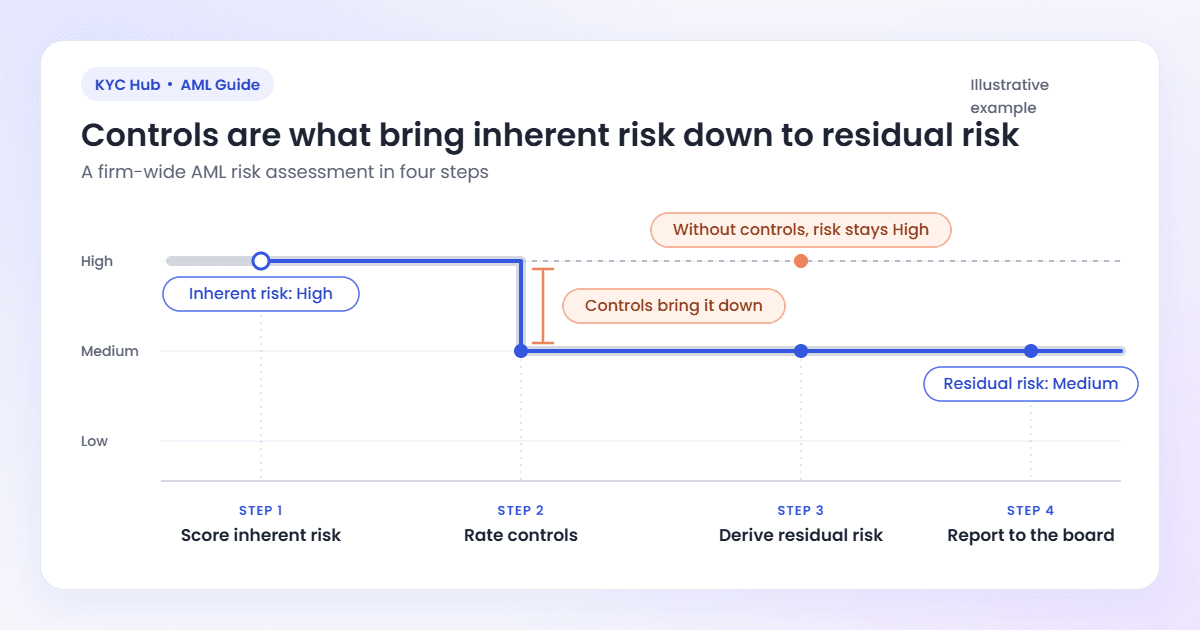
An AML risk assessment is a financial institution's documented judgment of its own exposure to money laundering and terrorist financing across customers, geographies, products and delivery channels, measured once before controls and again after them. Supervisors tend to read it first. The rest of the AML program is meant to follow from it: how far enhanced due diligence reaches, which monitoring scenarios run, and where staff and budget go.
Customer risk rating is often mistaken for it, although that exercise scores individual relationships and is only one input to the firm-wide view. The method is not complicated. A team scores inherent risk factor by factor and rates the controls on evidence; combining the two gives residual risk, which goes to the board. Where assessments usually fall short is in the weights, the evidence behind each control rating, and keeping the result current.
What an AML risk assessment is, and how it differs from customer risk rating
The firm-wide assessment takes the institution itself as its subject. UK supervisors call it a business-wide risk assessment, and US practitioners often say enterprise-wide. For each risk factor it produces an inherent risk level and a rating of how well controls mitigate that risk. Residual risk follows, per factor and for the firm as a whole, along with an action plan for anything above the board's risk appetite.
Firm-wide AML risk assessment | Customer risk rating | |
|---|---|---|
Subject | The institution | One customer relationship |
Question answered | How exposed is the business to ML/TF, before and after controls? | How much due diligence and monitoring does this customer need? |
Output | Inherent, control and residual ratings per risk factor, plus an action plan | A low, medium or high rating that sets CDD, EDD and monitoring |
Main users | Board, senior management, MLRO, supervisors | Onboarding, KYC and monitoring teams |
When it changes | Periodically and on material change in the business | At onboarding, on trigger events and at periodic review |
Our guide to customer risk rating factors and models covers the factors behind relationship-level ratings, from customer type and ownership to PEP status and geography. The firm-wide view needs the resulting distribution of customers across tiers and the direction that mix is moving.
Each level informs the other. The Reserve Bank of India's 2024 Internal Risk Assessment Guidance covers both and says individual outcomes should guide the weights used at business level; if high-risk customers make up a growing share of one segment, the customer factor's weight should rise. The FCA approaches the link from the opposite side. Its Financial Crime Guide (FCG 3.2.3) treats as good practice a risk assessment that visibly informs the design of AML controls, and its November 2025 review of firms' risk assessments praised firms whose business-wide risks flow into customer risk scoring through weightings or sub-factors.
Where the requirement comes from
The obligation originates with FATF and is implemented differently in each jurisdiction. What follows is guidance rather than legal advice; the governing text for the reader's entity type is the one to check.
Jurisdiction | Legal basis | Status | Review frequency |
|---|---|---|---|
FATF | Recommendation 1 and its Interpretive Note | International standard that countries implement | Keep up to date |
UK | MLR 2017 reg 18 (ML/TF) and reg 18A (proliferation financing) | Legal requirement | Keep up to date; FCA expects regular review |
US (banks) | FFIEC BSA/AML Examination Manual; FinCEN and banking agency proposals of 2026 | Examiner expectation; express requirement proposed, not final | No fixed cycle; update on significant change |
India | RBI KYC Directions, 2025, para 10 (commercial banks and NBFCs) | Regulatory requirement | Set by the board, at least annually |
FATF. Under Recommendation 1, countries must make financial institutions identify and assess their money laundering, terrorist financing and proliferation financing risks, then take effective action to mitigate them. The interpretive note sets the coverage at customers, countries or geographic areas, products, services, transactions and delivery channels. The assessment must be documented and kept up to date. Competent authorities should be able to obtain it, and its depth should match the nature and size of the business.
United Kingdom. Regulation 18 of the Money Laundering Regulations 2017 makes this law for every relevant person, meaning any business within the regulations' scope. The same factor families apply. Firms must take supervisory information into account and keep the assessment proportionate, as an up-to-date written record the supervisor can request. Since September 2022, regulation 18A has added a separate proliferation financing risk assessment. No fixed annual cycle is set, although the FCA expects regular review, and its 2025 review cited formal annual review, as opposed to a simple refresh, as good practice.
United States. For banks, the FFIEC BSA/AML Examination Manual calls a BSA/AML risk assessment "not a specific legal requirement." Examiners nonetheless review it when scoping an exam, and where a bank's is missing or inadequate they complete one themselves. That position may change. FinCEN's proposed rule, published in the Federal Register on 10 April 2026, would require every BSA-covered institution to maintain risk assessment processes covering products, services, distribution channels, customers and geographic locations. Those processes would review and, as appropriate, incorporate the AML/CFT Priorities, and be updated promptly after a significant change in risk. The OCC, FDIC and NCUA issued aligned proposals the same day, and the Federal Reserve followed in July 2026. FinCEN's comment period closed on 9 June 2026, and as of 18th November 2026, no final rule has been published.
India: an institution-level clock and a customer-level clock. Para 10 of the RBI (Commercial Banks – KYC) Directions, 2025 and para 10 of the NBFC equivalent require commercial banks and NBFCs respectively to carry out and document an ML/TF risk assessment across clients, geographies, products, services, transactions and delivery channels. The board or a board committee sets its frequency, at least annually, and receives the outcome, which is also made available to competent authorities. Customer risk categorisation under para 20 is a separate obligation: the low, medium and high classification described in our post on how banks assign customer risk categories, which para 41(1) requires to be reviewed at least every six months. Customers therefore run on a six-monthly clock, while the institution has an annual minimum.
The institution-level requirement dates from April 2020, when RBI inserted it into the 2016 KYC Master Direction. RBI's 2024 guidance, which applies to all its regulated entities including payment system operators, describes its methods as indicative.
How to run an AML risk assessment, step by step
The AML risk assessment methodology below follows RBI's Internal Risk Assessment Guidance of October 2024, among the few scoring methods a regulator has published in detail. RBI calls the guidance indicative, and its structure adapts readily to a UK or US program.
1. Scope, ownership and the team
Scope extends to every business line, legal entity and jurisdiction the institution operates in, plus a group-level view where it belongs to a group. Someone must own the methodology by name, with a sign-off route to the board or a board committee. RBI's guidance cautions against leaving the exercise to the AML team. Product owners hold information the assessment depends on, as do operations, internal audit, and the fraud and cyber risk functions.
2. Gather internal and external data
Internal data records what the institution actually does. That covers customers by type and risk tier, product and transaction volumes, and the channel mix across branch, digital, agents and intermediaries. Geographic exposure belongs here too, with alert and suspicious activity report data and any audit or supervisory findings. For the customer factor, the most direct input is the split of customers by risk tier, which is only as current as the customer risk rating behind it. External sources supply context: the national risk assessment, FATF's lists of jurisdictions under increased monitoring and those subject to a call for action, supervisor and FIU advisories, and published typologies.
Volume alone says little about risk. The FFIEC manual illustrates this with two banks that send the same number of international funds transfers a day. Most of one bank's are recurring, documented payments for long-standing customers, while most of the other's are one-off transfers or are sent for non-customers.
3. Inherent risk, scored by factor
Inherent risk means exposure before any control applies. The team breaks each of the four factor families (customers; geographies; products, services and transactions; delivery channels) into sub-factors. A sub-factor's weight reflects how much it contributes to the factor, and the weights sum to 100%. Its score, a separate measure, reflects how much of it the institution carries. The weighted sum becomes the factor's inherent score, mapped to High, Medium or Low.
PEP exposure shows why the distinction matters. It can carry a heavy weight, since PEPs bear heavily on the customer factor, and still score low at an institution with few of them. RBI's guidance also puts guardrails on weighting. No single factor should dominate, and profitability should play no part; an upward override is acceptable when the reason is documented.
4. Control effectiveness
For each factor, the team lists the mitigating controls: governance and assurance, policies, CDD and EDD, sanctions screening, transaction monitoring, suspicious transaction reporting, independent testing, record keeping and training. Each control is weighted and rated on evidence such as test results, audit findings or quality assurance samples. Those ratings roll up to Strong, Satisfactory or Weak for the factor. A control written into policy but never tested has little evidence behind it and is rated on that basis.
5. Residual risk against appetite
A matrix usually combines each factor's inherent level with its control rating to give residual risk, and the firm-wide residual is the weighted average across factors. Every level needs a written definition; otherwise "Medium" can mean something different to the board this year than it did last year. The result is then set against the board's stated risk appetite.
6. Acting on the result and keeping it current
When residual risk exceeds appetite, the institution can cut inherent risk by restricting or exiting a product, channel or segment. Alternatively it strengthens controls such as EDD triggers, monitoring scenarios and screening coverage. Each action needs an owner and a deadline; the FCA's 2025 review found few firms recorded either. The FFIEC also expects independent testing to examine the assessment itself and the way it shapes the program.
Methodology, results and action plan go to the board or a delegated committee. Off-cycle reviews follow material change: a new product, practice or technology, entry into a new jurisdiction, an acquisition, a new national risk assessment, or significant audit or supervisory findings. New products are a legal trigger in two of the four regimes: UK law (MLR reg 19(4)(c)) and RBI (para 72 of the Commercial Banks Directions, para 68 of the NBFC Directions) both require the risk to be assessed before launch.
A worked example
The figures are illustrative, applying RBI's structure to one firm's numbers. Everything runs on a 1 to 3 scale, where 3 marks the highest inherent risk and, for controls, the greatest effectiveness. A mid-sized payments firm starts with its customer factor.
Sub-factor | Weight | Score (1–3) | Weighted |
|---|---|---|---|
Cross-border merchant share | 40% | 3 | 1.20 |
Ownership complexity | 25% | 3 | 0.75 |
PEP exposure | 20% | 1 | 0.20 |
Non-resident customers | 15% | 2 | 0.30 |
Inherent score | 100% | 2.45 (High) |
Scores below 1.67 count as Low and those above 2.33 as High, with Medium covering 1.67 to 2.33. The firm then rates the controls on the customer factor.
Control | Weight | Effectiveness (1–3) | Weighted |
|---|---|---|---|
Onboarding CDD and EDD | 50% | 3 | 1.50 |
Periodic risk rating review | 30% | 1 | 0.30 |
PEP and sanctions screening | 20% | 2 | 0.40 |
Control score | 100% | 2.20 (Satisfactory) |
For controls, 2.50 or above is Strong and anything under 1.75 is Weak; Satisfactory covers 1.75 to 2.49. Periodic review scores only 1, because quality assurance found a backlog of overdue reviews.
The firm's residual matrix:
Inherent risk | Strong controls | Satisfactory controls | Weak controls |
|---|---|---|---|
High | Medium | High | High |
Medium | Low | Medium | High |
Low | Low | Low | Medium |
With High inherent risk and Satisfactory controls, the customer residual comes out High. After repeating the exercise for the other factors, the firm rolls them up, counting High as 3, Medium as 2 and Low as 1, and applying the same bands as for inherent risk.
Factor | Weight | Residual | Weighted |
|---|---|---|---|
Customers | 35% | High (3) | 1.05 |
Geographies | 25% | Medium (2) | 0.50 |
Products, services and transactions | 25% | Medium (2) | 0.50 |
Delivery channels | 15% | Low (1) | 0.15 |
Firm-wide residual | 100% | 2.20 (Medium) |
Most of that result comes from the customer factor. If the firm cleared its review backlog, the control score would rise to 2.80 (Strong) and the customer residual would fall to Medium. The firm-wide figure would drop to 1.85: still Medium, but close to the Low boundary.. That shows the board where remediation effort belongs.
What goes in the risk assessment document
Supervisors meet the assessment first as a document. RBI's guidance specifies what the report should contain, and the same headings serve a UK or US assessment:
Section | What a reviewer looks for |
|---|---|
Profile, executive summary, threats faced | The business as it is today, and the conclusions in a page |
Methodology | Factors, weights, scales, band definitions and dated data sources |
Inherent risk, controls, residual risk | Evidence behind each control rating; residual set against appetite |
Mitigation measures | An owner and a deadline for every action |
Enforcement and audit history | Supervisory and law enforcement actions in the last five years, audit findings, case studies |
Approval record | Who approved it, when, and which version |
In the UK, regulation 18 also requires a written record of the steps taken, so the document has to show how the assessment was done as well as what it found.
Where firm-wide assessments go wrong
Some failures sit in the assessment itself; others sit in the customer ratings that feed it and corrupt the firm-level picture from below. The FCA and RBI describe both.
- A generic assessment. One that oversimplifies risks or leans on fraud while neglecting money laundering, sanctions and proliferation financing (FCA, 2025), or that is too generic to reflect the institution's own activities (RBI).
- Judgment with no numbers. Purely qualitative scoring, or a methodology that never explains how inherent risk was assessed (FCA, 2025).
- Growth outpacing the assessment. New products, services or customer types launched before anyone checks whether controls still fit (FCA, 2025).
- Actions with no owner. Findings that never become tracked, owned actions (FCA, 2025).
- A borrowed assessment. A UK branch or subsidiary leaning on the group's assessment without checking local requirements (FCA FCG 3.2.3).
- A score nobody can explain. A vendor model or score the institution cannot explain to its supervisor (RBI), or model changes made without testing (FCA, 2025).
- Customer ratings bent out of shape. A classification that makes High almost impossible to reach, higher-risk countries scored low to avoid EDD, relationship managers overriding scores without evidence, or ratings swayed by profitability (FCA FCG 3.2.3). RBI separately warns against weights shaped by profitability.
- No feedback loop. Customer-level results never fed back into the factor weights (RBI).
Each failure cuts the assessment off from the risk-based approach to compliance it is meant to anchor. If FinCEN finalizes its proposal as drafted, a US bank whose assessment already satisfies examiners would still need to show that it has reviewed the AML/CFT Priorities and built them in where they apply, and that a significant change in risk triggers an update.
Make customer risk data work harder for your firm-wide assessment. Your institution-level risk assessment is only as reliable as the customer risk data feeding into it.
See how KYC Hub helps financial institutions assess customer risk, maintain consistent risk classifications and create an auditable record of the decisions behind them..
Book a demo to explore KYC Hub's customer risk rating capabilities.