Compliance Workflow Software: How It Works and How to Choose
Compliance workflow software is an application that ties together the repetitive steps in a regulatory process and runs them as one orchestrated sequence. Think identity verification at the front. Then risk assessment, sanctions and PEP screening, the case work that follows, and the audit reporting at the end, all of it stitched into a single flow instead of a pile of disconnected manual tasks. Work routes itself. Risk rules apply the same way every time. Each action gets logged, which clears cases faster, trims errors, and keeps compliance teams audit-ready as regulation tightens. KYC Hub applies this approach across the financial-crime lifecycle.
Here is what this guide covers. Starting with what the software actually does, we then walk a workflow from intake to outcome. After that comes the part where automation and no-code orchestration fit in, a method for sizing up vendors, and the case for KYC Hub when a team wants one platform from onboarding through ongoing monitoring.
What is Compliance Workflow Software?
Compliance workflow software is an application built to manage and run compliance processes of various kinds. Organizations use it to lighten the load of identity checks. Threat appraisals get the same treatment, and so do sanction screening and document controls, all of which the software pulls into one place by gathering data from different sources. Because it runs on AI and ML, compliance moves quickly, stays consistent, and produces fewer errors.
Take onboarding as an example. AI and machine learning verify a customer's identity at signup and flag risky customers within seconds. Paperwork drops away, yet the relevant industry regulations still get followed.
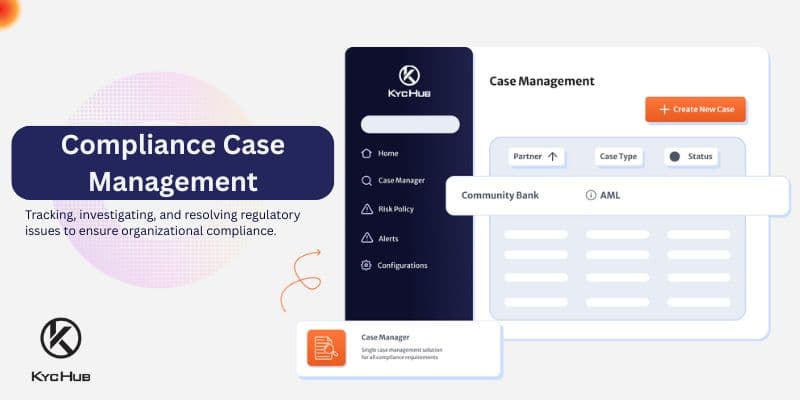
The category bumps up against a few adjacent terms. Compliance automation is the underlying technique. It swaps manual steps for rules and AI. Workflow orchestration is the sequencing layer. It governs how those automated steps get ordered and routed, then passed across teams and systems. Case management is the workspace where flagged alerts and investigations get worked to a decision. A capable compliance workflow automation platform puts all three in one place. The alternative is gluing a screening tool to a ticketing system to a spreadsheet and hoping the seams hold.
How a Compliance Workflow Works, Step by Step
A compliance workflow is a repeatable, documented sequence. Picture a customer or a regulatory obligation moving from intake all the way to a defensible outcome. Automation leaves the stages themselves untouched while stripping out the manual handoffs between them. Most financial-crime workflows move through six stages.
- Identify and intake. The workflow captures the trigger, a new customer applying to onboard, a periodic review falling due, or an alert raised by monitoring, and pulls the required data and documents into one record. At onboarding this is usually where identity verification runs.
- Map and risk-assess. Each case gets scored against your risk policy. Rules and AI models weigh factors such as jurisdiction, customer type, product, and ownership structure to produce a risk score that decides the path the case takes.
- Screen. The customer and connected parties are checked against sanctions lists, watchlists, PEP databases, and adverse media for AML compliance. Matches are graded so that clear non-matches are auto-cleared and genuine hits are escalated.
- Monitor. Approved customers are screened continuously and their transactions watched for unusual patterns, so changes in risk, such as a new sanctions designation or a sudden change in behaviour, are surfaced without a manual re-check.
- Investigate and remediate (case management). Anything the rules cannot clear lands in a case queue. An analyst reviews the consolidated evidence, adds time-stamped notes, requests further documents if needed, and records a decision.
- Report and audit. The outcome is documented, regulatory reports such as a suspicious activity report are filed where required, and every step is preserved in an immutable audit trail for examiners.
Here is the real payoff. Stages 1 through 4 run with little or no human touch. Low-risk cases pass straight through, which frees analysts to spend their hours only on stage 5, the cases that genuinely call for judgement.
Benefits of Compliance Workflow Automation Software
Across industries, businesses that adopt compliance workflow automation software report the gains below.
1: Increased Efficiency
The first benefit people notice is efficiency. Drop manual data entry. Drop document verification too, and a company redirects its people to work that actually needs them. A Know Your Customer (KYC) or Anti-Money Laundering (AML) check that once dragged on anywhere from an hour to several days now finishes in minutes. Onboarding speeds up. Productivity climbs with it, and clients are happier for the change.
2: Enhanced Accuracy
Accuracy is the next big one. AI and ML automation cut the kinds of errors that creep into manual compliance work all the time. Primary data stays consistent under the software. Discrepancies trigger timely alerts, false positives drop, and organizations get a cleaner basis for decisions as a result. Every record stays accurate, so audit readiness improves and regulators have more reason to trust the program.
3: Cost Savings
Cost savings follow naturally. Strip out the constant, monotonous tasks and general overhead inside an organization comes down with them. Automation also lowers the odds of a non-compliance penalty by a wide margin. A malfunction or a basic mistake brings an expensive aftermath, fines and reputational damage included, and that whole tail of cost gets pushed out of the picture.
4: Scalability
Scaling is another real advantage. As a business grows and regulators ask for more, automated systems chew through larger data volumes and more involved processes without losing a step. Compliance grows alongside the company. Room to expand, with some confidence behind it, comes out of that.
5: Real-Time Monitoring
Legislation shifts fast, and any serious compliance tool now has to monitor in real time. Automated solutions keep live status on nearly every risk. Sanctions violations get watched, so do politically exposed persons (PEP) and money laundering cases. Catching risks before they escalate, a business stays continuously compliant and holds its ethical line.
So compliance workflow automation software lets a business hit its compliance goals while staying tuned for productivity, expense, and growth inside an ever-heavier regulatory environment.
AML Workflow Automation and Case Management
Of everything in this category, AML workflow automation draws the most regulatory scrutiny, because it governs how alerts turn into investigations and how investigations turn into decisions. Modern AML workflows automate the admin. Alert triage, case assignment, deadlines, access rules, all of it runs in the background while teams put their effort into the decisions that matter.
Case management is the operational core. Picture a unified workspace that ties detection tools, data sources, and analysts together so every potential threat gets investigated the same way. Strong case management capabilities worth looking for include:
- A single-screen view that brings the customer profile, screening hits, transaction history, and prior notes together, so an analyst is not switching between systems mid-investigation.
- Automated assignment and prioritisation that routes the highest-risk cases to the right analyst first and applies SLAs and deadlines automatically.
- Bulk decision-making, so a reviewer can apply the same determination across many similar alerts at once instead of clearing them one by one.
- Time-stamped notes and mandatory rationale before a case can be closed, so every decision carries a documented justification.
- A complete, immutable audit trail capturing who did what, when, and why, including status changes, risk-score recalculations, and rescreening events.
False positives swamp alert volumes in most programs. That single fact puts intelligent triage at the top of the feature list. AI and machine learning auto-resolve the clear non-matches and escalate only genuine risk. Leading platforms report processing a large share of profiles this way, with no human intervention at all.
No-Code Workflows and Workflow Orchestration
One request surfaces again and again from buyers. Change a compliance workflow without waiting on engineering, they say. No-code compliance workflow software answers that. It hands compliance teams a visual, drag-and-drop builder. They design and adjust their own processes, set risk rules, and launch new workflows directly, no code and no IT ticket. Why does this carry weight? Because rules change constantly. A new sanctions regime can demand a workflow change inside a few days. So can a revised threshold or a fresh product line.
Workflow orchestration is the layer above. It sequences those steps and wires them into the rest of your stack. Useful orchestration features include:
- Conditional routing and decisioning, so a case follows a different path depending on its risk score, customer type, or jurisdiction.
- No-code rule configuration, so thresholds, escalation logic, and approval steps are owned by the compliance team.
- API and webhook integration, so events such as case creation, status changes, and workflow completion can trigger updates in your CRM, core systems, or downstream tools in real time.
- Versioning and governance controls, so changes to a workflow are tracked, testable, and reversible, an audit requirement in its own right.
Orchestration is what turns a loose collection of automated checks into one coherent, end-to-end process. An analyst, a system, and an auditor can then all follow the same thread.
How to Choose Compliance Workflow Software
Picking a platform gets easier once you score every option against a consistent checklist. A feature demo alone won't get you there. The criteria below separate the capable platforms from the rest.
- Define the outcome first. Decide whether your priority is faster onboarding, lower false-positive volume, multi-jurisdiction coverage, or audit readiness. The right platform adapts to your workflow rather than forcing you to adapt to it.
- Coverage of the full lifecycle. Look for one platform that handles onboarding, KYB, screening, monitoring, and case management, so you are not integrating four point tools and reconciling them.
- Configurability without code. Confirm that your team can build and change workflows, rules, and risk scoring through a no-code interface, not a change request.
- Integration depth. A compliance workflow is only as strong as the systems it connects to. Check for prebuilt connectors plus open APIs and webhooks to your CRM, core banking, identity, and ticketing tools.
- Audit trail and reporting. Insist on a searchable, time-ordered record of who changed what and when, with auditor-ready exports mapped to your obligations. This is the difference between a smooth examination and weeks of evidence-gathering.
- Data and global reach. Verify the breadth and refresh frequency of sanctions, watchlist, PEP, and adverse-media data, and the jurisdictions covered.
- Total value, not list price. Weigh the reduction in manual workload, fines avoided, and analyst time saved against subscription cost, and ask vendors for case studies in your industry.
Want to put this checklist against a live platform? KYC Hub's Compliance Workflow Automation runs the full lifecycle through one no-code builder, so Book a Workflow Automation Demo and see it scored on your own workflow.
Which Industries Need Compliance Workflow Software?
Some industries face stringent regulatory oversight, and for them compliance workflow software is essential. These include:
- Financial Services: Banks, fintech companies, and payment providers need tools to comply with KYC, AML, and other regulations.
- Healthcare: Automating compliance ensures patient data security and adherence to regulations like HIPAA.
- E-commerce: Platforms must verify sellers and buyers to prevent fraud and maintain marketplace integrity.
- Real Estate: Automating due diligence helps firms comply with AML regulations and identify risky transactions.
- Insurance: Insurers use automation to speed up claims processing and assess fraud risks.
The 2026 Regulatory Backdrop
Regulators keep tightening the screws. Fall foul of the rules now and it costs a lot more than it did a few years back. The EU's new AML package has crossed from law into live supervision. The Anti-Money Laundering Authority (AMLA), headquartered in Frankfurt, became operational on 1 July 2025 and will directly supervise up to 40 of the highest-risk obliged entities. From 10 July 2027, the single AML Regulation (AMLR) and the sixth directive (AMLD6) apply in full, harmonising rules such as a 25% beneficial-ownership threshold across member states. Standards bodies including the FATF keep setting the global baseline that national regimes follow.
What does that mean day to day for a compliance team? Workflows have to bend quickly when thresholds, data requirements, and reporting formats shift. They also have to produce a clean audit trail the moment someone asks. Absorbing exactly that pressure is the whole point of compliance workflow software. A rule changes, you update a configuration, and nobody retrains a manual process.
How KYC Hub's Compliance Workflow Automation Fits
Everything above describes what good compliance workflow software should do. KYC Hub's Compliance Workflow Automation is built to do it. The product maps to the same lifecycle this guide walks through, and a few capabilities matter most for the way businesses run these workflows day to day.
- No-Code Customization. Your compliance team builds and edits workflows, risk rules, and decision logic in a visual builder. A new sanctions regime or a revised threshold becomes a configuration change, not an engineering ticket, so the workflow keeps pace with the rules.
- Dynamic Customer Risk Assessment. Risk scores update as the picture changes, feeding the routing decisions at stages 2 and 4 above. A case that gets riskier gets re-prioritised on its own.
- Built-in integration with verification services. Identity checks, screening, and document tools connect into one flow through APIs and connectors, so you are not bolting a screening tool onto a ticketing system and reconciling the gaps by hand.
- Managed Services. Teams short on in-house compliance headcount can lean on KYC Hub's specialists to help run and tune the program, which keeps audit-readiness intact even when the team is small.
- Time and Cost Savings. Auto-clearing low-risk cases and routing only genuine risk to analysts is what pulls manual hours, and the overhead attached to them, back out of the process.
Together these turn the six-stage flow into one configurable, end-to-end system, with the immutable audit trail and reporting examiners ask for built into every step. Want to see it run on your own workflow? Book a Workflow Automation Demo.
Conclusion
As regulatory pressure climbs, a firm can lean less and less on a manual, spreadsheet-driven approach to compliance. Compliance workflow software does a lot of the heavy lifting here, getting a program to better outcomes on effectiveness, quality, sustainability, and cost. Score platforms on lifecycle coverage, no-code configurability, integration depth, and audit readiness, and KYC Hub holds up on every one. With our service behind them, organizations build a growth strategy and leave the weight of compliance behind.