What is Proof of Address Singapore?
Understanding the key aspects of address proof in Singapore is vital for individuals and companies. This guide provides an in-depth overview of the significance, requirements, and ways to obtain proof of address in Singapore.
What is Proof of Address Singapore?
Address Proof in Singapore refers to a document that verifies an individual’s or a company’s current residential or business address within the country. This document should link the person’s or company’s name to their active address in Singapore, affirming the legitimate use of the said residence or business location.
The acceptable proof of address in Singapore includes utility bills, bank statements, lease agreements, water, electricity, gas, telephone, internet bills, government-issued ID cards with addresses, and recent credit card statements.
Why Do Banks and Other Industries Need Proof of Address?
The importance of proof of address transcends various industries, particularly banking and other financial sectors. Its primary role is to be a critical component of the Know Your Customer (KYC) norms, integral to security measures and Anti-Money Laundering (AML) compliance procedures.
Banks and financial institutions require address proof in Singapore to ensure the applicant’s authenticity and prevent fraudulent activities, such as identity theft, money laundering, and terrorism financing. Other industries, like telecommunications and insurance, require proof of address to confirm accurate service delivery and billing.

What Are Accepted as Proof of Address in Singapore?
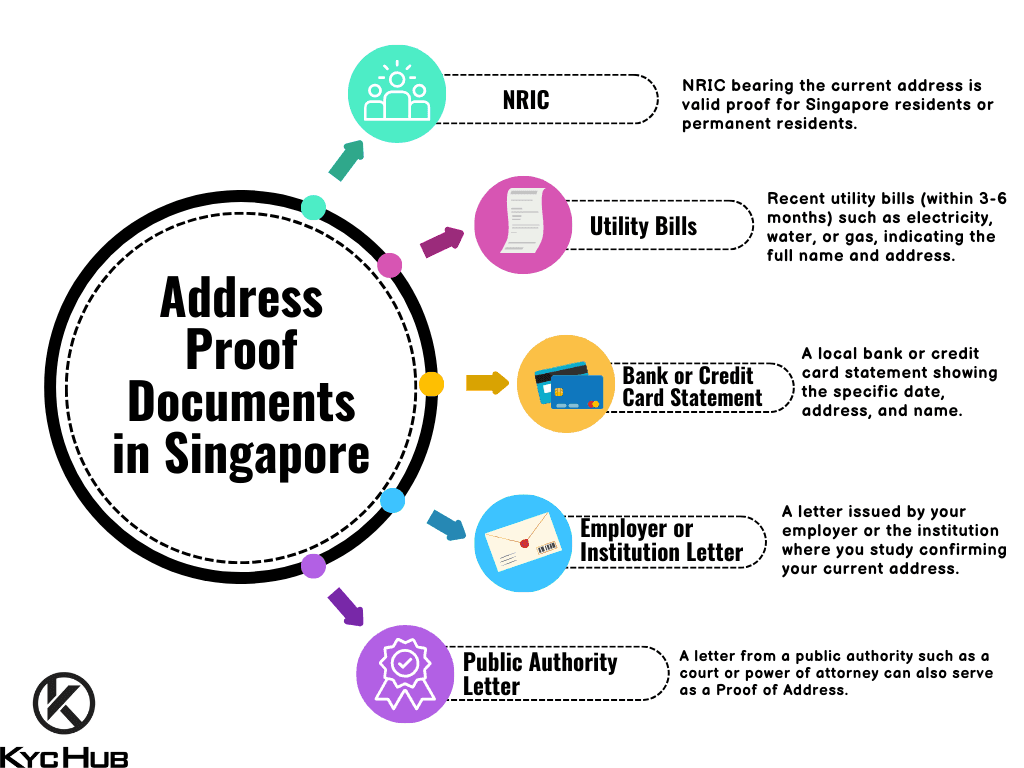
A variety of documents can serve as Proof of Address in Singapore. However, the accepted documents may vary depending on the requesting organization’s specifications. Here are some commonly acknowledged proofs of address:
- National Registration Identity Card (NRIC): The NRIC bearing the current address is valid proof for Singapore residents or permanent residents.
- Utility Bills: Recent utility bills (within 3-6 months) such as electricity, water, or gas, indicating the full name and address.
- Bank or Credit Card Statement: A local bank or credit card statement showing the specific date, address, and name.
- Employer or Institution Letter: A letter issued by your employer or the institution where you study confirming your current address.
- Public Authority Letter: A letter from a public authority such as a court or power of attorney can also serve as a Proof of Address.
- Mortgage Agreement: A recent (within one year) mortgage agreement indicating your address.
Remember, documents furnished as Address Proof in Singapore should be recent, bearing the current address, and issued by a recognized authority to be considered valid.
Additional verification
Another practical and time-saving alternative to physically getting papers is to use geolocation data for verification of residence. Businesses should still consider using geolocation-based proof of address solutions as a supplementary step during customer due diligence (CDD), even if authorities haven’t fully adopted them yet.
Several pieces of information may be used by a geolocation-based solution to determine the user’s exact location:
- Location using Wi-Fi
- GPS data
- IP data
- Trilateration on cell towers
What documents are not acceptable as proof of address in Singapore?
Documents that are often not accepted by companies include:
- Unverified by any official government agency
- Past the time when they are valid
- Bills or receipts for goods purchased
- Retirement plans
- Patron IDs
- Photocopies of original documents

How do you get proof of address in Singapore?
Obtaining Proof of Address in Singapore involves a systematic process. You can approach the respective organization or authority depending on the document type you choose as Proof of Address.
For instance, if you need a utility bill, you can request a physical copy from the utility company. Similarly, you can contact your bank for bank or credit card statements.
You can acquire Singapore’s Proof of Address through various means. If you are a resident, your NRIC, utility bills, bank statements, and lease agreements can serve as Proof of Address.
For foreign residents and expatriates, a valid passport, a letter from your employer or educational institution, or an In-Principle Approval (IPA) granted by the Ministry of Manpower can suffice.
Businesses can provide recent company bills or a valid company lease agreement as proof of their business address. However, depending on the bank or government agency’s requirements, they may require additional or specific documents.
Do Businesses Need Separate Proof of a Singapore Business Address?
Yes, businesses operating in Singapore need separate proof of their business address. The business address where the company operates is distinct from the registered office address, where the company maintains its official records.
For sole proprietors or small-scale business owners, their home address can be the business address under the Home Office Scheme. In other cases, companies need to provide their office address or business operation site. A recent company bill or a valid company lease agreement can serve as Address Proof in Singapore for the business address.
Why Choose KYC Hub for ID and Address Proof Verification?
KYC Hub offers Global AML solutions, simplifying the complex procedures of ID and address proof verification. Businesses can ensure thorough and reliable verification processes by choosing KYC Hub and remaining compliant with Singapore’s AML regulations. It streamlines the verification process, making it hassle-free and convenient for its clients.

Conclusion
Understanding the importance and process of obtaining proof of address in Singapore is crucial for individuals and businesses. Providing accurate and valid documents, such as Proof of Address ensures smooth transactions across various services and complies with Singapore’s regulations.
Compliance requirements change by market, and most KYC tools only cover one. KYC Hub's global KYC solution adapts across jurisdictions without a rebuild. See a demo.