What is Money Laundering?

Money laundering, a term often thrown around in news reports and crime dramas, is a real and pervasive issue that affects the global economy. Understanding its mechanisms is not just crucial for law enforcement and financial institutions, but for anyone who participates in the financial system.
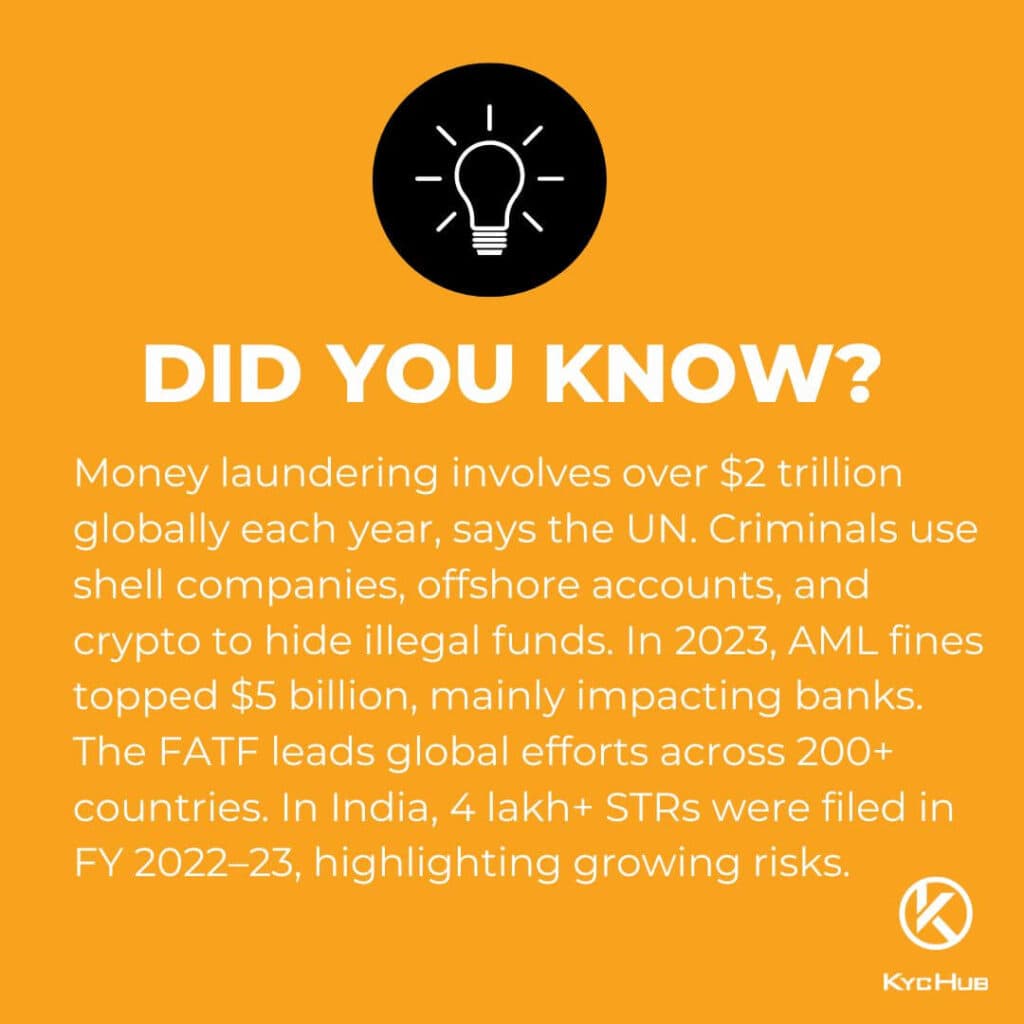
Money laundering is a global problem that has plagued the financial industry for decades. As illicit funds flow through the financial system, they can be used to finance terrorism, organized crime, and other illegal activities. According to the UN, the amount of money laundered globally each year is estimated at 2 to 5% of global GDP, or roughly $800 billion to $2 trillion. In order to conceal illicit funds, criminals use complex techniques like cryptocurrencies, offshore accounts, and shell companies.
The majority of the $5 billion in global anti-money laundering (AML) fines in 2023 were imposed on banks. The Financial Action Task Force (FATF) leads international AML efforts, and more than 200 countries and jurisdictions have committed to implementing its standards. More than 4 lakh Suspicious Transaction Reports (STRs) were submitted in FY 2022–2023 in India alone.
Financial institutions and regulatory bodies have developed anti-money laundering (AML) measures to prevent, detect, and report suspicious transactions to combat this. However, the fight against money laundering is never-ending, and criminals continuously find new ways to exploit the system. Taking proactive measures in AML prevention is essential, including leveraging technologies.
What is the Meaning of Money Laundering?
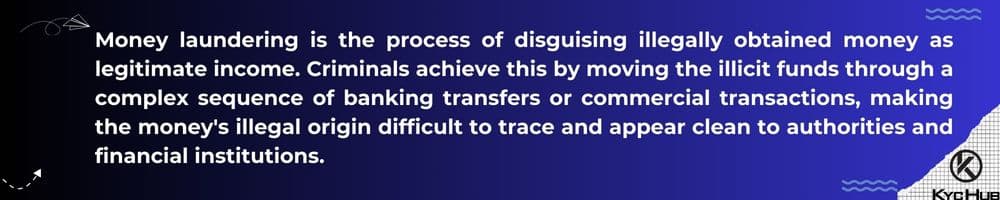
Money laundering means making illegal money look like it came from legal sources. It usually happens in three steps: placing the money into the system, hiding its true origin, and then mixing it with clean money. Laundering money can cause serious issues, like economic volatility, damaging the trust in banks and businesses, and helping crimes and corruption grow.
Prominent instances of illicit money flow, such as the notorious Zhenli Ye Gon affair in Mexico or the scandal involving Danske Bank in Europe, underscore the magnitude and intricacy of these schemes. These episodes emphasize the importance of alertness and sturdy mechanisms to identify and thwart such practices.
Al Capone: Origin of the Term Money Laundering
The term “Money Laundering” originates from a real-life scenario in America. Al Capone, also known as Alphonse Gabriel Capone, born in Brooklyn, is an infamous anti-hero who disguised the illegal origins of his income during the Prohibition era with laundromats. He committed various crimes during the Prohibition Era, including bootlegging, bribery, narcotics trafficking, and robbery.
On June 5, 1931, authorities charged Capone with 22 counts of federal income tax evasion for the years 1925 to 1929. On June 12, authorities charged Capone and his gang with breaking the law from 1922 to 1931. He stood trial in court and was found guilty on five of the counts for which he was charged. He had to pay a $50,000 fine and serve an 11-year prison sentence. Capone was in jail for a long time and was released on parole in November 1939. After being freed, he relocated to Florida, where he passed away in January 1947.
Money Laundering came to be known as a crime of obtaining or sabotaging cash flow, revenue, and investments through tricks and techniques. This method involves concealing the source of “black money” and channeling it into the legitimate financial system. The money is usually from illicit acts like drug trafficking, fraud, or corruption, which makes it a crime.
3 Stages of Money Laundering
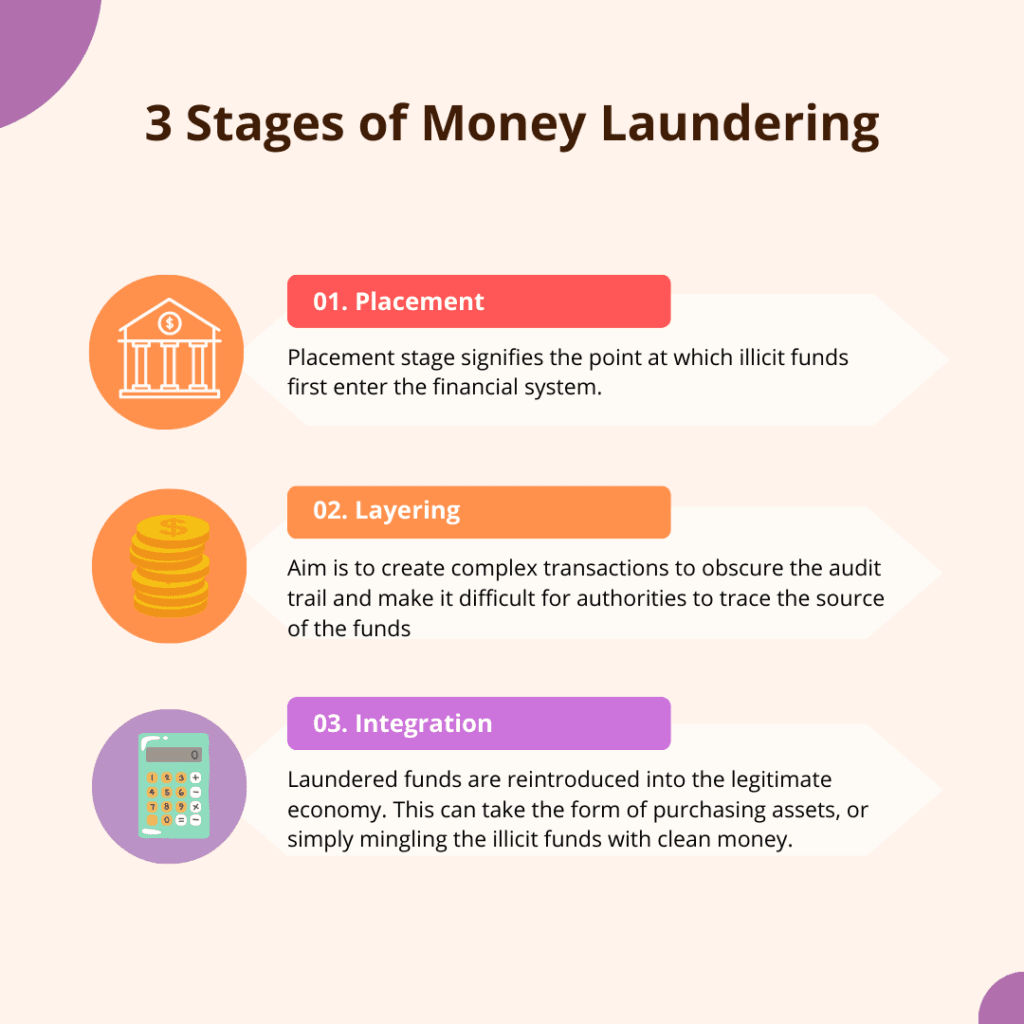
The process of laundering money can be broken down into three stages:
- Placement
- Layering
- Integration
1: Placement
Placement, the initial stage of money laundering, involves getting illicit money into the financial system without attracting attention. Techniques used in this stage often include depositing large amounts of cash into a bank account or purchasing valuable assets with cash that can then be sold. Financial institutions combat placement by implementing robust Know Your Customer (KYC) procedures and monitoring large cash transactions.
2: Layering
Layering, the second stage, involves creating a complex network of transactions to obscure the source of the money. This source might be transferring money to and from various accounts, often across different countries, changing the money’s form through investments, or purchasing assets to change the money’s form. Financial institutions use transaction monitoring systems and anomaly detection algorithms to identify suspicious patterns that might indicate layering.
3: Integration
The process of money laundering culminates in the integration stage, during which the ‘laundered’ money, now camouflaged and untraceable to its illicit beginnings, is woven back into the formal economy.
Examples of Money Laundering
There are several ways that money laundering can occur, from intricate plans to what appear to be harmless transactions. Real estate purchases are a common strategy when illegal money is transferred through the purchase of real estate. Trade-based money laundering also covers up illicit gains in business dealings. Criminals might hide behind virtual currency to maintain their identities online.
Shell businesses, which frequently have no active business activity, act as conduits to conceal the source of funding. These illustrations highlight the various and creative tactics that thieves use, highlighting the critical requirement for effective anti-money laundering measures in the current financial environment.
Common Methods of Money Laundering
-
Trade-Based Laundering:
Trade-based money laundering involves over- or under-invoicing goods and services to move money across borders. Launderers reconcile their books with illicit money by manipulating the price, quantity, or quality of a good or service.
-
Shell Companies and Trusts:
These are inactive companies or legal entities used as a vehicle for financial maneuvers, helping obscure the true origin of the money. They often exist only on paper and have no physical presence or employees.
-
Offshore Accounts:
Criminals often use accounts in countries with strict bank secrecy laws to hide money and its origin. These jurisdictions often have lax AML laws, making hiding large sums of money easier.
-
Digital Currencies:
With the rise of cryptocurrencies, digital transactions have become a new frontier for money laundering. The anonymity provided by cryptocurrencies makes tracking transactions difficult.
-
Smurfing:
Smurfing involves breaking down a large transaction into several smaller transactions to avoid suspicion. These smaller transactions are then deposited into one or more bank accounts or used to purchase assets.
-
Round-Tripping:
In this case, individuals deposit money into a regulated foreign corporation located offshore, ideally in a tax haven with minimal record-keeping. They then return the money as foreign direct investment, which is typically exempt from taxes.
-
Casinos:
A person can buy chips with illicit cash, gamble only a small amount, and then redeem the remainder for a check from the casino. This makes it appear as though the earnings are legitimate gambling winnings.
The Role of Financial Institutions in Preventing Money Laundering
Financial institutions could play a key role in preventing the illicit flow of money. They must comply with Anti-Money Laundering (AML) regulations, including the Know Your Customer process, transaction monitoring, and reporting suspicious activities.
Technology plays a crucial role in preventing the laundering of money, with the use of Artificial Intelligence (AI) and Machine Learning (ML) to detect suspicious activities. It is also crucial to train employees to recognize the indicators associated with money laundering and know the correct steps for reporting such activities.
The Impact of Money Laundering
Money laundering is not just a criminal problem; it can have far-reaching effects that can destabilize economies and undermine the integrity of financial institutions. Providing a financial lifeline to organized crime facilitates activities such as drug trafficking, terrorism, and corruption. It can also distort market dynamics, leading to inflation and asset bubbles. In essence, money laundering threatens economic stability and societal well-being.
Entities Governing Regulations Around Money Laundering
- Bank Secrecy Act (BSA)—The Bank Secrecy Act (BSA) mandates U.S. financial institutions to aid U.S. government bodies in identifying and thwarting money laundering incidents. This involves reporting any transactions exceeding $10,000 and any suspicious behavior that could indicate money laundering, tax evasion, or other illicit activities.
- EU Anti-Money Laundering Directive The EU has several AML directives, the latest being the 6th Anti-Money Laundering Directive (6AMLD), which came into effect in December 2020. The directives provide a coordinated set of rules to help combat money laundering and terrorist financing across the EU.
- UK Proceeds of Crime Act (POCA): POCA provides the legal framework for the recovery of the proceeds from crime. It includes measures to make it harder for criminals to launder money and makes it easier for law enforcement agencies to recover assets gained through criminal activity.
- Financial Action Task Force (FATF) Recommendations: The FATF is an intergovernmental body that sets international standards for combating money laundering and terrorist financing. The FATF Recommendations provide a framework for countries to implement effective measures to combat money laundering.
- U.S. Money Laundering Control Act: This Act makes money laundering a federal crime. It prohibits individuals from engaging in financial transactions with proceeds generated from certain specific crimes, known as “specified unlawful activities” (SUAs).
- U.S. Patriot Act: The Patriot Act, passed in response to the 9/11 terrorist attacks, broadened the extent of lawful surveillance to fight terrorism. This includes clauses related to money laundering and funding of terrorism. Title III of the Act, also known as the International Money Laundering Abatement and Financial Anti-Terrorism Act of 2001, includes measures to halt, identify, and prosecute international money laundering and terrorist financing.
Anti-Money Laundering Measures
Anti-Money Laundering (AML) measures are a set of procedures, laws, and regulations designed to stop the practice of generating income through illegal actions. These are:
- Customer Due Diligence (CDD)
- Transaction Monitoring
- Reporting of Suspicious Activities
- Record Keeping
- AML Compliance Program
- Risk Assessment
- Use of Technology
Here’s a more detailed look at the key components:
1: Customer Due Diligence (CDD):
Customer Due Diligence includes confirming a customer’s identity and evaluating risk levels. Enhanced Due Diligence (EDD) is carried out for customers posing a higher risk to gain a more in-depth understanding of their activities and manage the associated risks.
2: Transaction Monitoring:
Financial institutions monitor transactions to identify patterns that could indicate illegal activity. This involves tracking customers’ transactions over time, and keeping track of their transaction patterns while flagging anomalies or suspicious behavior for further investigation.
3: Reporting of Suspicious Activities:
If a financial institution suspects that a transaction may be related to money laundering, it is required to file a Suspicious Activity Report (SAR) with the relevant authorities.
4: Record Keeping:
Financial institutions are required to keep records of all transactions for a certain period to aid in investigations when a SAR is filed.
5: AML Compliance Program:
Financial institutions are required to implement an AML compliance program, which includes the appointment of a designated AML compliance officer, ongoing employee training, and an independent audit function to test the program.
6: Risk Assessment:
Financial institutions are required to conduct a comprehensive risk assessment of their customer base and their transactions to understand where their greatest vulnerabilities lie.
7: Use of Technology:
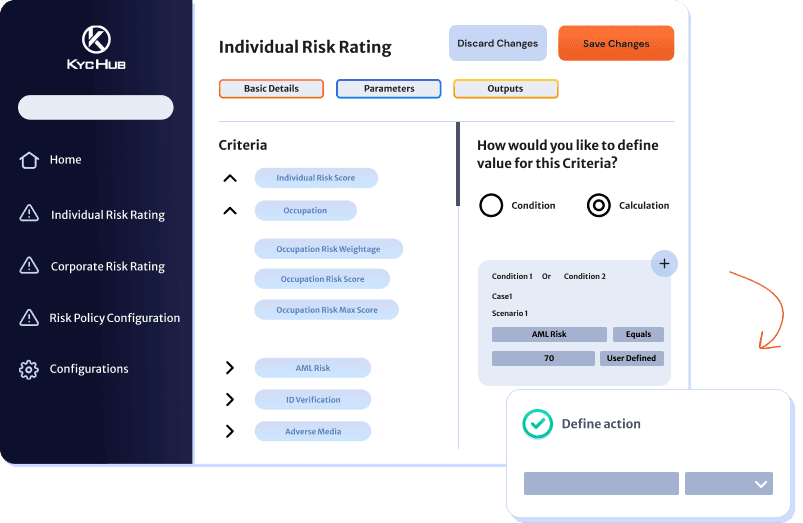
With financial transactions’ increasing volume and complexity, several financial institutions use advanced technologies like artificial intelligence and machine learning to automate and enhance their AML efforts. These technologies can help identify patterns and anomalies that human analysts might miss.
What is Hawala Money Laundering?
Hawala is an informal or traditional money transfer system that operates outside traditional banking channels. It is widely used in regions with weak financial infrastructure. Transactions occur through trusted brokers, leaving little to no paper trail. This enables the movement of illicit funds across borders, evading financial regulations.
How to Prevent Money Laundering?
Criminals use various methods to launder their money, such as smurfing, layering, and integration. Smurfing involves breaking down large sums of money into smaller amounts below the reporting threshold. Layering involves moving funds through multiple accounts or jurisdictions to conceal the source of the money. Integration involves using laundered funds to purchase legitimate assets.
The financial industry is responsible for preventing money laundering within its system. AML measures are in place to detect and report suspicious transactions to regulatory bodies. These measures are designed to identify potential money laundering activity, prevent criminals from accessing the financial system, and protect the integrity of the financial industry.
Best Practices for Money Laundering Prevention
Financial institutions can use several best practices to prevent money laundering. These best practices include:
A risk-based approach involves assessing the risk associated with individual customers, products, and services. This allows financial institutions to allocate resources effectively and focus on high-risk areas.
2. Internal Controls
Internal controls are policies and procedures designed to prevent money laundering within a financial institution. This includes implementing transaction monitoring systems, conducting regular risk assessments, and training employees on AML measures.
3. Customer Due Diligence
Customer Due Diligence involves conducting background checks on customers and third-party service providers. This ensures that financial institutions are not inadvertently facilitating money laundering activity.

The Role of Financial Institutions in Preventing Money Laundering
- The role of financial institutions in preventing money laundering has become increasingly important in recent years. Anti-Money Laundering (AML) measures have been implemented globally to combat the illegal activities of money laundering and terrorist financing. Financial institutions play a crucial role in the fight against money laundering, as they are often the first line of defense.
- AML regulations require financial institutions to identify and verify the identities of their customers, monitor transactions, and report any suspicious activity to the authorities. The regulations also require financial institutions to establish and implement internal policies, procedures, and controls to prevent and detect money laundering.
- Financial institutions must be vigilant and conduct thorough due diligence on their customers, especially those with a higher risk of money laundering. This includes politically exposed persons (PEPs), high-risk countries, and individuals or entities with complex ownership structures.
- The consequences of failing to comply with AML regulations can be severe, including hefty fines, reputational damage, and legal action. Therefore, financial institutions must invest in training employees and implementing robust AML compliance programs to ensure they are adequately equipped to prevent and detect money laundering.
- Financial institutions play a significant role in preventing money laundering. By implementing AML regulations, conducting thorough due diligence on customers, and establishing robust compliance programs, financial institutions can effectively combat the illegal activities of money laundering and terrorist financing.
Official and Governmental References on Money Laundering Prevention
For those seeking authoritative insights and guidelines on money laundering prevention, several governmental and official bodies provide invaluable resources:
- U.S. Department of the Treasury: The Department of the Treasury plays a pivotal role in the U.S.’s efforts to combat money laundering both domestically and internationally. Their dedicated section on Money Laundering offers a comprehensive overview of their initiatives and strategies.
- FinCEN (Financial Crimes Enforcement Network): As a bureau of the U.S. Department of the Treasury, FinCEN safeguards the financial system from illicit use, combats money laundering, and promotes national security. Their guide on Money Laundering Prevention is a must-read for financial institutions seeking to bolster their AML measures.
- United Nations Office on Drugs and Crime: Recognizing the global nature of money laundering, the UNODC provides a thematic compilation of measures taken by States parties to prevent money laundering. Their section on the Prevention of Money Laundering offers insights into international efforts in this domain.
- FINRA (Financial Industry Regulatory Authority): As a not-for-profit organization authorized by Congress, FINRA protects America’s investors by ensuring the broker-dealer industry operates fairly and honestly. Their section on Anti-Money Laundering provides guidelines and best practices for financial institutions.
Conclusion
Money laundering is a complex but crucial subject to understand as it affects the economy at large and each of us indirectly. It is also essential for businesses and financial institutions to have robust systems in place to combat this issue. KYC Hub provides comprehensive solutions for identity verification, anti-money laundering, and other compliance needs. Our advanced solutions can play a significant role in detecting, preventing, and reporting money laundering activities.
Are you an entity that deals with financial transactions? Don’t leave yourself vulnerable to the risks of money laundering. Explore how KYC Hub’s advanced anti-money laundering solutions can secure your business. Contact us for a free consultation or if you have any questions about our services.