A7 Network: How Sanctions Evasion Beat Name Screening
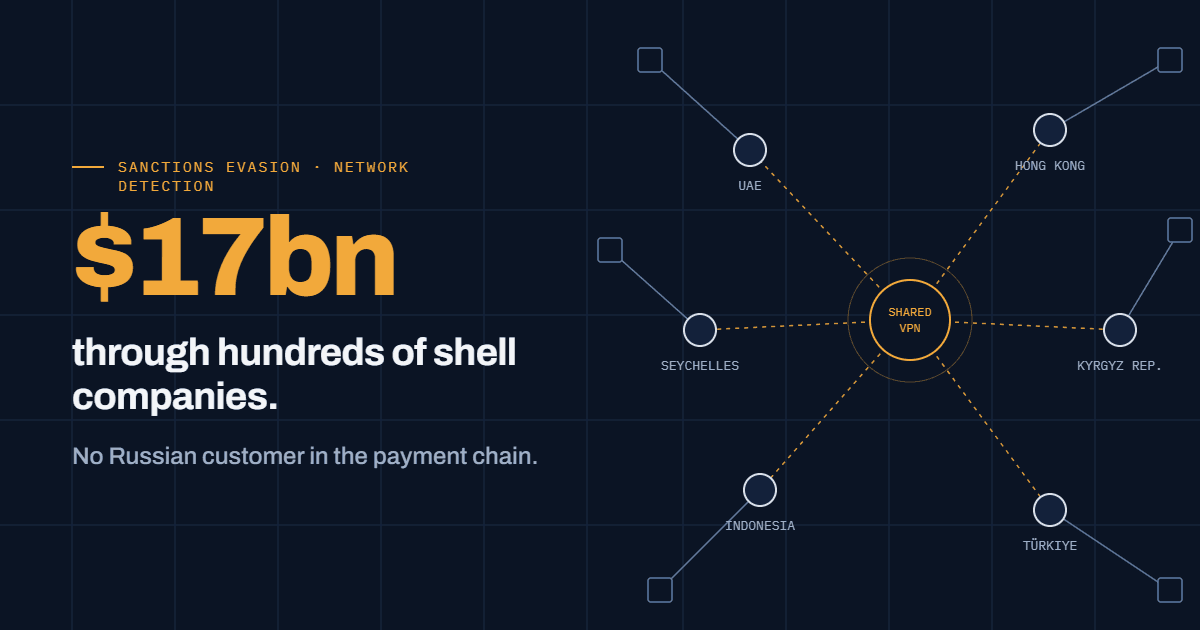
Sanctions evasion network detection became a board-level phrase in October 2026, when the US Treasury designated the A7 Network as a transnational criminal organization and FinCEN published a proposed rule and an alert describing how it works. It is now the reference case for sanctions evasion network detection. According to FinCEN, the foreign shell companies A7 calls sub-agents processed more than $17 billion in USD-denominated transactions between January 2025 and June 2026. By June 2026 they held accounts at about 435 financial institutions in at least 83 countries. The scheme was built so that no Russian or other sanctioned customer appears in the payment chain, and FinCEN says it commonly leaves banks as unwitting accomplices.
Reading the Federal Register notice, the FinCEN alert, the UK National Crime Agency's August flash alert and the two New York Times investigations built on A7's leaked records together, we have put the mechanism in one place. The practical point: a sub-agent payment was designed to pass list-based controls. So the question for a compliance team is what else in the transaction, the customer file or the correspondent relationship carried the signal?
Key takeaways
• A7 is a mirror system. Rubles stay in Russia, suppliers are paid from money A7 already holds abroad, and the only thing that crosses the border is an instruction.
• Sub-agents are represented as owned by non-Russian nationals and operated from Moscow over VPNs: the corporate mule-account pattern at scale.
• A7’s invoicing software used ChatGPT and a database of thousands of company stamps. Several FinCEN red flags are the defects it leaves behind.
• The dollar leg ran through nested correspondent accounts, where 2016 Treasury guidance sets no general expectation that a bank vets its respondent’s customers.
• FinCEN’s proposed section 9714 rule names six sub-agents and would rely on a non-public list for the rest. US persons are already barred from dealing with A7 sub-agents under OFAC’s designation. Sanctions evasion network detection cannot wait for names.
How the money moved without leaving Russia
Inside Russia, a customer who needs to pay a foreign supplier buys a bill of exchange from A7, a promissory note the documents call a veksel, and the note becomes a credit on A7's internal ledger. Between 30 September 2024 and 22 July 2025 customers bought more than 3,200 of them, worth over $25 billion, according to FinCEN
Nothing crosses the border except an instruction. A7 holds bank balances on both sides, each in the name of a shell company it controls, and when a note is redeemed it pays the supplier from money that was already outside Russia and settles its own books between the two pools, so that, in the National Crime Agency’s words, “there is no correspondent bank transfer from Russia.” FinCEN compares the arrangement to mirror transactions in Chinese underground banking and the black-market peso exchange, where a broker pays each side in the other’s currency and the parties never meet.
Where does the foreign money come from? Partly from Russia’s own export revenue. In the first five weeks of 2025, nearly 400 million dirhams, roughly $100 million, of offshore proceeds linked to Russian energy exports were paid into First Abu Dhabi Bank accounts held by A7 shell companies in the UAE, and converted into dollars, euros and Tether, according to records examined by the New York Times. The Times reported that the documents do not establish Gazprom’s knowledge of A7’s role.
Sub-agents: the mule account pattern at corporate scale
Every payment goes through a sub-agent. Sub-agents are shell companies with bank accounts. A7 forms them, buys them or partners with them in Hong Kong, Indonesia, the Kyrgyz Republic, the Seychelles, Türkiye and the UAE, and by June 2026 there were hundreds of them holding accounts at about 435 financial institutions. On paper each company is owned and directed by nationals of the country it is registered in.
Their accounts are typically operated by A7 staff in Moscow over VPNs that, FinCEN says, depend on infrastructure from IT companies controlled by Ilan Shor, A7’s co-founder. The connections often appear to come from Dubai, Hong Kong or the Kyrgyz Republic. A7 also builds the websites and email addresses its staff use when they deal with banks, according to the NCA.
Retail fraud teams know this pattern as a mule account. Corporate banking has fewer names for it. In a mule account, the holder is real and local and has nothing to do with the activity, the operator is somewhere else, the stated purpose of the account differs from its use, and the session geography has been faked to match the paperwork. Mule detection in retail banking looks for exactly these mismatches between holder, operator and behavior, and the same logic applies to a trading company in a free zone whose account is accessed from VPN infrastructure FinCEN has now named. The same mismatches are the basis of shell company detection in corporate banking.
Paperwork is produced by software. First the customer gives A7 the supplier's bank details, a description of the goods and the price, and A7 picks a sub-agent whose registered line of business matches the goods, so an electronics supplier is paid by a company that appears to trade in electronics. A7's invoicing program reads the real invoice with ChatGPT and writes a new one for the same amount and date with the goods and the buyer changed, after which an employee picks a company stamp from a database of more than 6,000 stamps, the Times found. In March 2025 an invoice for nearly $46,000 of signal measurement sensors came out the other side as LED advertising light boxes bought by the Trading Company of the Kyrgyz Republic, and the supplier's bank raised no compliance issue.
The matching is not perfect. FinCEN notes that A7 "at times struggles to match Sub-Agents with specific customer business profiles." Sometimes the network fails at this. A trading company registered for food and beverages paying for machine tools is the mismatch the method tries to avoid, which is why an AML transaction monitoring rule that compares the goods paid for against the registered activity of the payer is more likely to surface this network than a name screen.
The correspondent layer, and the customer nobody vets
Dollars travel one step further up. Rarely does a sub-agent's bank in Bishkek or Hong Kong have an account in the United States, so it holds one at a larger bank that does, and that bank holds its own at a Wall Street firm. Zhejiang Chouzhou Commercial Bank, a regional lender in Yiwu, is the middle of that chain for a great many institutions the New York Times reported. Nearly 70 other banks got dollar access through it, against 20 for ICBC and seven for HSBC, and it processed more than $200 billion in international transactions in 2024, about four times its total assets.
Until June 2025 Chouzhou's dollars ran through a pooled account at Bank of America, number 0252, holding funds from countless Chouzhou customers, among them more than 50 companies that sold restricted electronics, industrial chemicals and other goods to Russia in the first four months of that year. In one January 2025 payment a Russian company bought $73,000 of components for electronic warfare systems from a Hong Kong distributor, and First Abu Dhabi Bank sent the money to Chouzhou's account at Bank of America. Bank of America received the transfer order. Purchase details stayed with the banks below it.
Correspondent banking is designed this way, and the design is a regulatory choice. The 2016 Treasury and banking agencies’ joint fact sheet sets no general expectation that a US bank conducts due diligence on its foreign respondent’s customers, and the Wolfsberg questionnaire that banks use for that purpose asks about the respondent's controls. AML for correspondent banking therefore runs on a different unit of analysis from retail AML. The customer is a bank. What can be monitored is the respondent's aggregate behavior, meaning the share of its traffic that is nested and comes from banks further down that the US institution has never onboarded, the concentration of payments into particular corridors, and the gap between what a respondent of its size should be sending and what it sends. Chouzhou's 2024 volume at four times its balance sheet is that kind of number. Bank of America closed the account in June 2025 without public explanation, and soon after Chouzhou opened dollar accounts at Citibank and Standard Chartered, the Times reported.
Rented treasuries: licensed firms that lend their accounts
A7's leaked records, reported by the Financial Times on 9 October 2026, add a layer the regulators only gesture at. Alongside the companies it controls, A7 keeps a list of what one internal note calls rented treasuries, independent licensed firms that will make payments for it alongside their other business. One was a small payment institution registered with the FCA in London, listed as holding an "extensive license" and as a route for payments to China and Hong Kong in renminbi and dollars. Payments were capped at $50,000 a day under the note, which also required a customs declaration with no Russian language on it before anything was agreed, and to explain the relationship A7 forged an invoice showing the London firm supplying it with cashmere sewing fabric. The FT identified one payment on this channel, of about $26,000.
Under UK rules a small payment institution must keep its volume under an average of €3 million a month (PSRs 2017, reg 14), and A7's daily cap keeps the route comfortably inside that. The route ran inside a regulated perimeter. Whatever made the firm useful to A7 is the registration that also obliges it to verify customers and monitor transactions.
A7A5: the ledger that keeps both sides level
The third part of the machine is the A7A5 stablecoin. A7A5 is a ruble-backed token issued by Old Vector, a Kyrgyz company, advertised as backed by ruble deposits at Promsvyazbank, the Russian state defense bank that co-owns A7. It runs on Tron and Ethereum. FinCEN found that more than 180 entities processed at least $179.1 billion in A7A5 transactions between February 2025 and June 2026.
Inside the network it represents payments made abroad, moving between wallets held in sub-agent names so that A7's own accounts stay balanced, and it is also a bridge into Tether and then fiat when banking channels close. Few US banks will ever see it. After a reported breach at the Grinex exchange on 16 April 2026, supply consolidated into unhosted wallets; by 28 July 2026, one wallet held 94.5% of the Tron supply, according to Crystal Intelligence.
A7 is not only a Russian problem. Treasury says the Central Bank of Iran and the IRGC have used the network, and that one sub-agent and a sister company received nearly $140 million from entities involved in Iranian sanctions evasion.
Why every control came back clean
Every sanctions program looks at the party in front of the bank: the originator, the beneficiary, the people who own them, the country they sit in. Underneath is the assumption that if a sanctioned party is involved in a payment it is somewhere in that chain, in a name, an ownership record or an address, and can be found with enough effort. A7 was built on the opposite assumption. Its sanctioned party stays outside the chain altogether, and FinCEN says the scheme commonly leaves banks as unwitting accomplices.
What sanctions evasion network detection looks like in practice
Name screening answers one question, whether a party is on a list. Sanctions evasion network detection asks whether a set of parties that are each clean share the infrastructure of a party that is designated. Here some of that infrastructure is public. FinCEN's alert gives two IP ranges, 159.100.19.150 to 152 and 159.100.19.203 to 214, from which sub-agent websites are served, and two mail servers, muzpan.com and sodkamus.com, to which their email domains resolve. Every company whose site or mail resolves there is a node in one network regardless of its name, its owner or its registered activity, and a bank that can join customer records on hosting, mail infrastructure, document templates and login geography will find the cluster before any of its members is designated.
Beneficial ownership checks fail on A7 for a specific reason. On the register the local nominee is a real person, the OAFC 50 percent rule finds no sanctioned owner, and the company's filings are consistent. Register checks clear every sub-agent. Beneficial ownership is where the control is designed to look, so the UBO layer was engineered to pass. What differs is who actually operates the account, which access and device signals can show. That comparison is the one that catches a mule, and it works on a shell company in a free zone for the same reason it works on a student's current account.
Transaction monitoring has usable signals here, and all of them are structural. A payer's registered activity against the goods on its invoice is one, since FinCEN says A7 cannot always keep them matched. Corridor movement is another: A7 itself said 78% of its transactions in August 2025 went through Chinese jurisdictions, and it has since opened offices in Nigeria and Zimbabwe and, the Times reported, extended operations into Bahrain and Mongolia after Western pressure. In correspondent banking the equivalent is a respondent whose dollar volume runs at several multiples of its balance sheet. All of it is in data the bank already holds, which is the point: sanctions evasion network detection is mostly a question of joining transaction monitoring, beneficial ownership and session data that are already collected and kept apart.
FinCEN’s A7 red flags, and what they have in common
FinCEN’s sanctions evasion red flags for A7 fall into three sets. No single flag is determinative.
Sub-agents and account access
• Transactions with suspected or known A7 sub-agents, or suspected shell companies in the Kyrgyz Republic or other A7 jurisdictions.
• Payments routed through several shell companies in multiple jurisdictions with no clear economic purpose.
• A recently formed company suddenly running high volumes of large transactions without recurring counterparties.
• Transactions with entities in disparate lines of business, or goods descriptions inconsistent with the supplier’s profile.
• Account access from IPs resolving to muzpan.com or sodkamus.com VPN infrastructure, or email domains resolving to mail servers affiliated with them.
• A blank or minimal website served from the IP ranges above.
Mis-invoicing and invoice falsification (see our guide to detecting AI-altered documents)
• Invoice templates that differ from previously observed standards.
• Vague product details, implausible prices, or dates that don’t fit the goods.
• An analog company stamp on an otherwise digital document.
• Out-of-place Cyrillic characters in English-language documents.
• Signs of AI generation or alteration: malformed letters, garbled wording, malformed seals.
Digital assets
• Exposure to A7A5 or wrapped A7A5 tokens.
• Stablecoins used for large trade payments, especially dual-use goods or oil.
• OTC or stablecoin desks with sudden, unexplained growth in A7-linked jurisdictions.
FinCEN asks filers to include the key term FIN-2026-A7NETWORK in SAR field 2 and the narrative. Reporters at the New York Times found the inside view of the same thing on a Chouzhou customer's invoice from 1 January 2025, which carried a notice in bold red telling anyone paying from Russia, the UAE or Türkiye to avoid the company's Bank of China account and warning that Standard Chartered could not be used even as an intermediary. Several describe the counterparty; the invoice flags are where A7’s software leaves its marks. They are the places where an invoicing program and a stamp library leave marks, and they are the only points in the transaction where Russia is still visible.
FinCEN’s proposed section 9714 rule and the non-public list
FinCEN's rule under section 9714 of the Combating Russian Money Laundering Act names six sub-agents, linked to about $67 million in illicit funds across periods from 2023 to 2025, and would prohibit covered financial institutions from transmitting funds involving A7 sub-agents. Everyone else goes on a list FinCEN shares through its secure portal. Comments close on 4 November 2026.
The proposal names six sub-agents, all UAE-based, linked to about $67 million in illicit funds across periods from 2023 to 2025. Once a final rule is issued, FinCEN would share a longer list of known sub-agents through its secure FI-Portal and limit the prohibition to listed entities. Banks would not be barred from telling a counterparty that a transaction was declined because of that list, and must notify affected direct counterparties. Banks would not be barred from telling a counterparty a transaction was declined because of the list.
The rule is not the only constraint. Since OFAC’s 1 October designation, property and interests in property of the A7 Network, including transactions by sub-agents acting for it, are blocked for US persons. For a bank outside the US the operational question is how to find the companies American institutions will stop paying before being told which ones. A7's own answer to every designation has been a team that forms new shells when old ones are cut, and its mascot, a nevalyashka, is the Russian roly-poly toy with a weighted base that rights itself whenever it is pushed over.
What compliance teams can do now
1. Load FinCEN’s VPN domains and IP ranges into access-log and onboarding checks, and run a look-back on corporate customers.
2. Review shell companies formed since late 2024 in the Kyrgyz Republic, UAE and Hong Kong with sudden high volumes.
3. Add a goods-vs-registered-activity check to trade payment monitoring.
4. Check for A7A5 or wrapped-token exposure and OTC desks in A7-linked jurisdictions.
5. Use FIN-2026-A7NETWORK in relevant SARs, and comment on the NPRM by 4 November if you are a covered institution.
Where KYC Hub fits
KYC Hub runs the checks this case turns on. In most compliance stacks, the gap is that these checks run apart; KYC Hub brings them onto one platform. GraphIntel maps relationships between entities, directors and high-risk parties from sanctions, registry, leak and media data, so a customer is assessed by the network it sits in. Transaction monitoring includes geographic, nature-of-transaction, linked-account and account-activity detectors for corridor shifts, purpose mismatches and changes in login or device behavior. Global KYB traces UBOs and directors across registries with continuous monitoring. Intelligent document processing extracts data from invoices, bills of lading and letters of credit and flags tampered documents. For trade-heavy books, see our guide to trade-based money laundering.
Each check is available on its own. Together they are what network detection means in practice, and a bank can see them running against its own data by booking a demo.
References
- FinCEN, "Proposal of Special Measure Prohibiting the Transmittal of Funds Regarding Transactions Involving the A7 Network's Sub-Agents," 91 FR 63208, 5 October 2026. https://www.federalregister.gov/documents/2026/10/05/2026-20371/proposal-of-special-measure-prohibiting-the-transmittal-of-funds-regarding-transactions-involving
- FinCEN, Alert FIN-2026-Alert007, "FinCEN Alert on the A7 Network," 1 October 2026. https://www.fincen.gov/system/files/2026-10/FinCEN-Alert-A7-Network.pdf
- US Department of the Treasury, "Operation Economic Outcast Takes Unprecedented Action Against Sanctions Evasion Network Used by Iran," 1 October 2026. https://home.treasury.gov/news/press-releases/sb0644
- UK National Crime Agency, National Economic Crime Centre, Flash Alert 0808-NECC, "A7 Sanctions Evasion Mechanism," August 2026. https://www.nationalcrimeagency.gov.uk/who-we-are/publications/826-necc-a7-sanctions-evasion-mechanism/file
- Aaron Krolik, "The 'Monster' Behind Russia's Global Effort to Evade Western Sanctions," The New York Times, 24 September 2026. 1. https://www.nytimes.com/2026/09/24/business/russia-sanctions-evasion-a7.html
- Aaron Krolik, "How a Small Chinese Bank Gave Moscow Access to Wall St.," The New York Times, 9 October 2026. https://www.nytimes.com/2026/10/09/business/correspondent-banking-russia-sanctions-evasion.html
- Chris Cook, Financial Times, 9 October 2026, on A7's leaked records and its use of licensed payment firms. https://www.ft.com/content/1273931a-238d-45a9-85b3-5c847e79b5ea
- US Department of the Treasury and the federal banking agencies, "Joint Fact Sheet on Foreign Correspondent Banking: Approach to BSA/AML and OFAC Sanctions Supervision and Enforcement," 30 August 2016. https://www.fincen.gov/news/news-releases/us-department-treasury-and-federal-banking-agencies-joint-fact-sheet-foreign
- The Wolfsberg Group, Correspondent Banking Due Diligence Questionnaire. https://www.wolfsberg-group.org/
- The Payment Services Regulations 2017, regulation 14 (small payment institution volume limit). https://www.legislation.gov.uk/uksi/2017/752/regulation/14
- Crystal Intelligence, "One wallet now holds 94.5% of A7A5's supply," 30 July 2026. https://crystalintelligence.com/stablecoin/one-wallet-now-holds-94-5-of-a7a5s-supply/
- Centre for Information Resilience, "A7 Abroad: Sanctions Evasion as a Service," October 2025. info-res.org/cir-2/reports/a7-abroad-sanctions-evasion-as-a-service/