Company Master Data on MCA: What Each Field Tells a KYB Reviewer
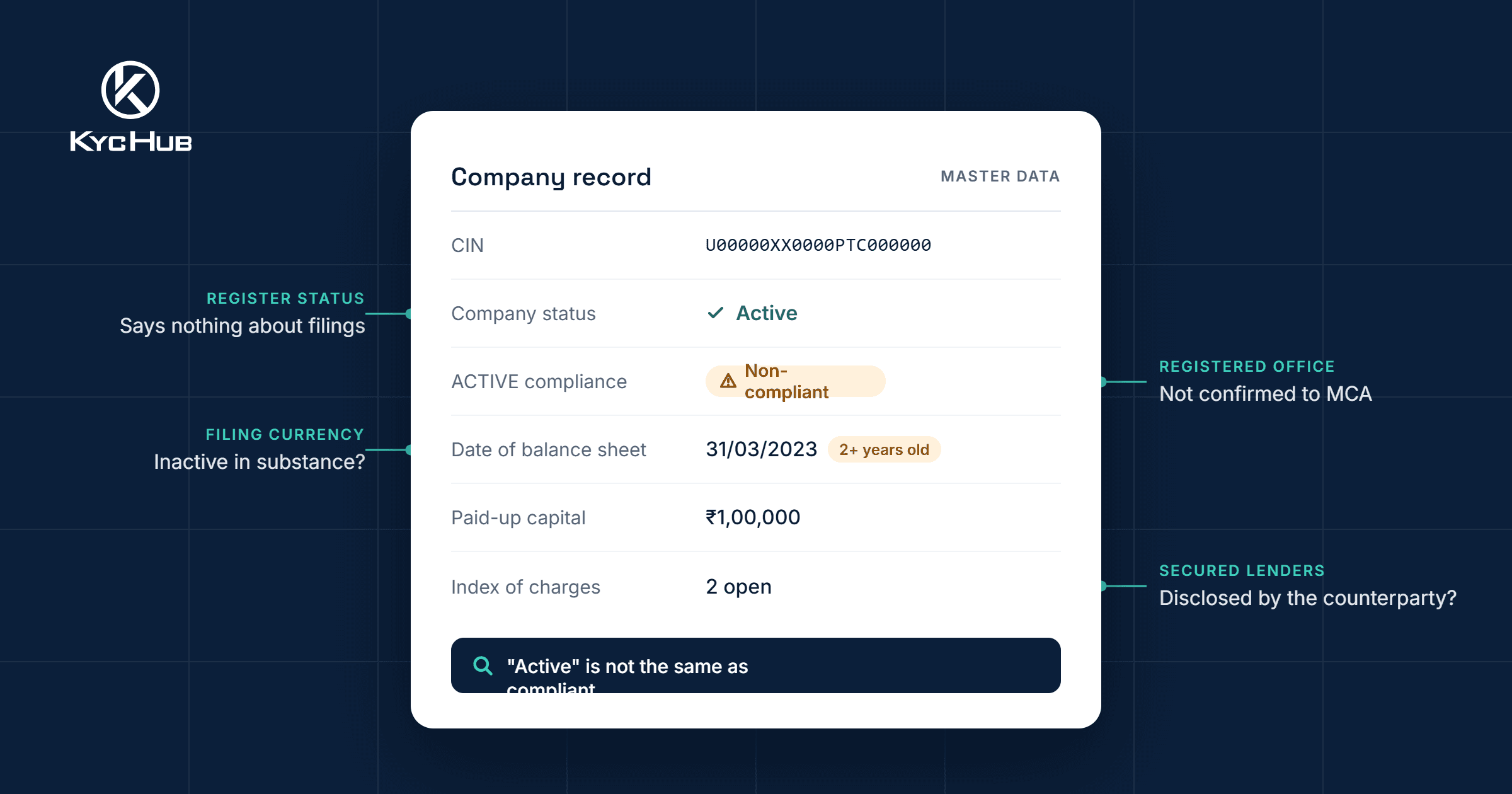
Company master data is the first registry check in almost every Indian KYB file. A CIN or name search on the website of the Ministry of Corporate Affairs MCA produces the record within a minute. Interpreting it takes longer. Each field reflects a filing obligation under the Companies Act, 2013, and a reviewer who reads only the company name and the word "Active" has missed most of what the record contains.
This guide works through the MCA company record one field at a time, covering what each value means, which values should halt an onboarding, and the places where MCA itself cautions against accepting a figure at face value. It is general guidance and does not constitute legal advice.
A printable checklist version of these checks is available to download.
Key takeaways
- "Active" is a register status. It says nothing about whether the company's filings are current; the balance sheet date, the last AGM date and the ACTIVE compliance flag answer that.
- MCA itself says the capital figures in its database may be incorrect. When capital matters to the decision, take it from the latest filed financial statements.
- A balance sheet date two or more years old on a company that claims to be trading is the same two-year test the Act uses to define an inactive company.
- The record lists directors, not beneficial owners, and carries no sanctions, PEP or adverse-media signal.
Where company master data comes from, and its limits
Company master data is published through Master Data Services on the MCA21 V3 portal, where both company and LLP master data can be viewed without a fee. Searching by CIN is quickest because it returns exactly one company. A name search serves when the CIN is unknown. LLPs and foreign companies sit in separate views, each with its own fields. Our guide to verifying a company through MCA, CIN and GSTIN covers the lookup steps and how the record fits with GSTIN and PAN checks. For volume work, MCA also releases the same core MCA data in bulk on data.gov.in, split RoC by RoC, as CSV files and an API.
The master data summarises what the company has filed. Behind it sit the documents themselves (financial statements, annual returns, charge instruments), which are public and cost ₹100 per company to view on the portal, under the inspection right in section 399 of the Act. Data providers compile the consolidated "MCA report" that bundles financials, shareholding and litigation; what the Ministry publishes is the master data and the filed documents.
Reading MCA company details, field by field
Most searches for MCA company details end up on the V3 company record, so the labels below follow it.
CIN, RoC and registration number
On incorporation, the Registrar allots a 21-character corporate identity number (CIN) and includes it in the certificate of incorporation under section 7(3) of the Companies Act, 2013. Alongside it, the record names the Registrar of Companies (RoC) holding the company's file and gives the registration number with that RoC. Every other check should resolve to the CIN, whether PAN, GSTIN, charges or a director lookup. A matching name with a mismatched CIN is not a match.
Company name and date of incorporation
The legal name on the PAN and GST registration should match this one exactly; our PAN verification guide covers that cross-check. Incorporation date deserves equal attention. Under section 248(1), the Registrar may strike off a company that has not commenced business within a year of incorporation, and a company formed eight months ago that claims a decade of trading is presenting someone else's history. What the reviewer needs to establish is which entity actually carried it.
Class, category and subcategory
Class distinguishes private, public and One Person Companies. Liability is recorded under category, as limited by shares, limited by guarantee, or unlimited. Subcategory then indicates government or non-government ownership; the "guarantee and association company" option exists only for companies limited by guarantee. Where a guarantee company appears as a trading counterparty, an explanation is warranted. An unlimited company alters the credit picture, since its members carry unlimited liability.
Authorised and paid-up capital
The memorandum sets authorised capital as a ceiling on share capital. Paid-up capital is what shareholders have actually paid on issued shares, and the useful test sets it against the scale of business the counterparty claims. A company with ₹1 lakh paid up that reports moving several crore in trade each year is thinly capitalised at best.
MCA warns readers about these fields. According to its annual e-filing guidelines, the authorised and paid-up capital in the MCA database needs verification by the companies concerned because it may be incorrect. When capital bears on the decision, the reviewer takes it from the latest filed financial statements. On V3, the paid-up figure is also updated by event-based forms such as PAS-3 and SH-7 rather than by the annual financial statements, so it can drift from the balance sheet. When capital bears on the decision, the reviewer takes it from the latest filed financial statements.
Registered address, books-of-account address and email
Under section 12, every company must maintain a registered office capable of receiving communications and notices. Some records show a second address because the board has chosen to keep the books of account elsewhere in India, which the company notifies to the Registrar on form AOC-5 within seven days (section 128(1)). The registered address should agree with the GST registration and with the contract. A site visit or video verification is justified when the office is shared with dozens of other companies or the email sits on a free webmail domain.
Listed in stock exchange(s)
A "Y" here means some of the company's securities are listed on a recognised stock exchange, which makes the company's stock exchange disclosures a second source for ownership and financials.
Date of last AGM, date of balance sheet, and filing information
These dates show whether the company is keeping up with its MCA filings. Under section 96, the annual general meeting (AGM) falls within six months of the financial year end, or nine months for the first. One Person Companies are exempt from holding an AGM (Section 96(1) of the Companies Act, 2013), so a blank AGM date on an OPC record is not by itself a warning sign. Financial statements follow on AOC-4 within 30 days of the AGM (section 137). The annual return is due within 60 days (from the AGM, or from the date on which the AGM should have been held if no AGM takes place) on MGT-7, or on MGT-7A for a small company or One Person Company (section 92(4)). On the V3 record, separate Balance Sheet Filing Information and Annual Returns Filing Information blocks carry the filing history.
One of the clearest red flags on the record is a balance sheet date two or more years old on a company that claims to be actively trading warrants further investigation. Section 455 also uses a two-financial-year period in its definition of an inactive company, although the statutory test considers additional factors beyond the age of the balance sheet.
Company status
Whether the file proceeds at all depends on status. The values below are those used in MCA's filing rules.
Status | What it means | What the reviewer does |
|---|---|---|
Active | On the register and not in any of the processes below | Proceed, then check filing dates and ACTIVE compliance |
Dormant under section 455 | Registered as dormant: formed for a future project or to hold an asset, or inactive for two years | Ask why a dormant company is entering a live relationship |
Under Process of Strike Off | The Registrar has given notice to remove the company | Do not onboard on the standard path |
Strike Off, Dissolved | Removed from the register | Do not onboard |
Under CIRP | In corporate insolvency resolution under the Insolvency and Bankruptcy Code | Escalate to compliance and credit |
Under Liquidation, Liquidated | Being wound up, or already wound up | Do not onboard |
Amalgamated, Converted to LLP, Converted to LLP and Dissolved | Merged into another company or converted to an LLP | Identify and verify the successor entity |
Not available for e-filing | The company currently cannot file on the portal | Ask the company why before proceeding |
No value is misread more often than "Active". It says nothing about whether filings are current, so the date fields and the ACTIVE flag have to be read alongside it. Strike-off is less final than it looks, too. Under section 252 , an aggrieved person can appeal a Registrar's strike-off order within three years, and the company, a member, a creditor or a workman can apply to the Tribunal for restoration up to twenty years after the strike-off notice is published. An old strike-off does not guarantee the entity stays gone.
ACTIVE compliance
Every company incorporated on or before 31 December 2017 had to file e-form INC-22A, the ACTIVE confirmation of its existence and registered office. Companies that did not file are marked "ACTIVE Non-compliant" by MCA, and their directors are tagged. The company is also barred from filing certain forms, including SH-7, PAS-3, DIR-12 (other than for a director's cessation) and INC-22, which means it cannot record a new registered office, a new director or a change in capital. A record showing "Active" status next to "ACTIVE Non-compliant" demonstrates why status alone settles nothing: the company is still on the register, but its address has not been confirmed to MCA, and the address and directors on the record may be out of date.
Auditors information
Auditors are listed on the V3 record, and the name there should match the auditor who signed the financial statements the counterparty supplies.
The index of charges
When a company gives security over its assets, it registers the charge with the Registrar on CHG-1 within 30 days of creation, then files CHG-4 once the charge is satisfied. As a result, the index of charges shows who already holds security over the counterparty's assets and how much of its borrowing is secured. Until the counterparty explains it, an open charge in favour of a lender it never mentioned should be treated as undisclosed debt. A charge still open for a loan the company says it repaid is a question for the relationship manager.
Directors and signatories
Current directors and signatories appear on the company record. Each director's DIN, other directorships and disqualification status require a separate lookup on the director's DIN.
Red flags in company master data
Each combination below is an indicator that calls for a follow-up step, not a conclusion.
What the record shows | What it may indicate | Next step |
|---|---|---|
Active, last balance sheet two or more years old | Inactive in substance | Request filed financials; check GST return history |
Active, but ACTIVE Non-compliant | Registered office not confirmed to MCA | Verify the address independently |
Token paid-up capital against large claimed turnover | Thin capitalisation or a pass-through entity | Request audited statements; screen for shell-company indicators |
Incorporated within the last year, claiming years of trade | Successor or front entity | Identify and verify the predecessor |
Shared or unreachable registered office, webmail email | Accommodation address | Site or video verification |
Open charges to lenders the counterparty did not disclose | Undisclosed borrowing | Reconcile with the counterparty's declarations |
Under Process of Strike Off, Under CIRP or Under Liquidation | The entity may not survive the relationship | Escalate; do not onboard on the standard path |
Use this on your next review
The MCA KYB Review Checklist puts every field check, company status action and red flag from this guide on two printable pages, with a reviewer sign-off block for your file.
Thin capital overlaps with the markers discussed in our post on shell companies in money laundering. KYC Hub's government database verification exists to run the registry check together with the PAN and GST checks as a single step, in place of a manual lookup for each registry.
What company master data cannot tell you
Directors appear on the record, but the individuals who ultimately own or control it are absent; finding them is a separate ultimate beneficial owner exercise. Shareholding pattern, financial statements and litigation history are absent as well and have to come from the filed documents and other sources. Nor does the record hold any sanctions, PEP or adverse-media signal. Capital and every other figure on it are only as current as the company's last filing.
A balance sheet date three years old means the capital and filing picture on the page describes the company as it stood three years ago, while the reviewer is deciding whether to onboard it as it stands today.