Stages of Money Laundering: Placement, Layering, and Integration
What Are the Stages of Money Laundering?
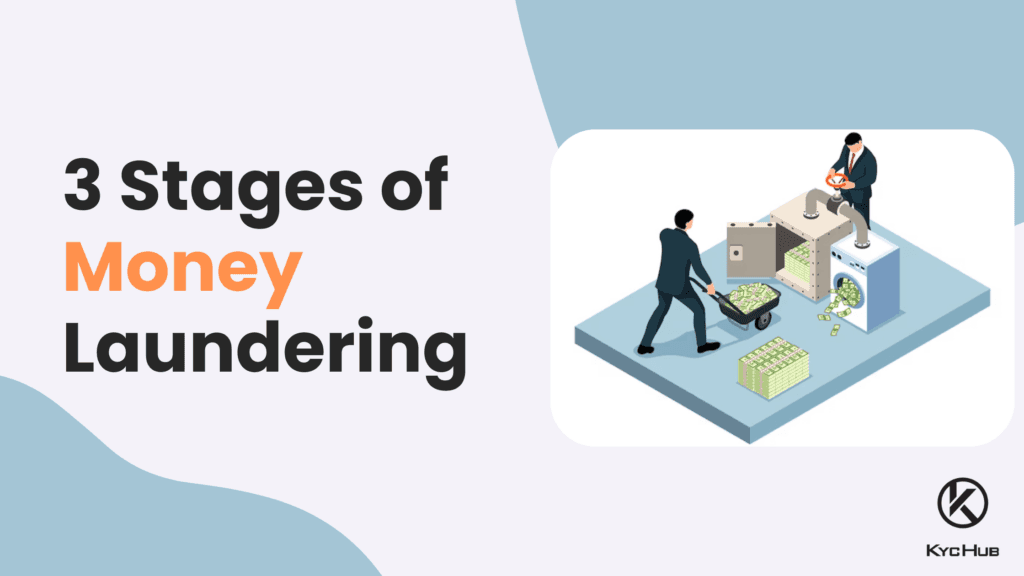
Money laundering moves through three stages: placement, layering, and integration. Placement is where illicit cash first slips into the financial system. Layering then pushes those funds through tangled transactions to break the audit trail, and integration returns the now clean-looking money to the economy as apparently legitimate assets. Because each stage leaves behind its own set of red flags, a detection program has to carry controls tuned to all three.
Why does this matter? Because the stages tell you where in the customer lifecycle each control has to fire. Placement risk clusters at onboarding and at the cash-handling edge of your business. Layering risk lives inside ongoing transaction monitoring. Integration risk surfaces when high-value assets and investments suddenly look legitimate. Watch only one stage and you leave the other two wide open.
The Three Stages of Money Laundering Explained
Money laundering disguises the origins of illegally obtained funds so they appear to come from a legitimate source. Dirty money rarely moves in a single step. It usually travels through three recognized stages, and each one serves a different purpose while exposing a different gap in your controls.
Stage 1: Placement
Placement comes first. Illicitly acquired funds, often physical cash, enter the legitimate financial system here. Launderers break large sums into smaller deposits, blend dirty cash with the takings of a cash-intensive business, buy monetary instruments such as money orders, or simply carry cash across borders into foreign accounts.
For the launderer, placement is the riskiest stage. Handling the money directly is exactly what exposes them to the people paid to watch for it, which makes it the most detectable stage for your controls. Compliance teams watch for structured deposits parked just below reporting thresholds, frequent cash activity that does not match the customer's stated profile, and money racing in and out of newly opened accounts.
Stage 2: Layering
Layering comes second. Here the placed funds run through a deliberately complex chain of transactions and bookkeeping maneuvers, so the original source grows hard to trace. Think transfers between dozens of accounts across jurisdictions, shell companies, assets bought and resold, money converted into financial instruments. Round-tripping is one quieter form: funds leave a country and return as foreign direct investment, reading as an ordinary investment return while the real source stays buried.
This is where the trail goes cold, which makes layering the hardest stage to detect. To catch it, modern transaction monitoring relies on behavioral and graph-based models that surface cross-account patterns simple rule-based systems miss. Watch for rapid pass-through activity with no clear business rationale, funds routed through multiple entities or jurisdictions in quick succession, and transactions structured to fragment a money trail across accounts and products.
Stage 3: Integration
Integration is the third and final stage. With a legitimate face now in place, the laundered money flows back into the economy through real estate, luxury assets, business ventures, or the financial markets. By this point the funds look like clean earnings. That is what makes integration the hardest stage at which to catch a criminal: all the effort to obscure the money has already paid off.
Integration red flags are subtler. Large asset purchases that clash with a customer's known income. Loan-back arrangements where a customer repays debt with funds of unclear origin. Sudden injections of capital into a business with no matching operating activity. Strong customer risk rating at onboarding, refreshed over the relationship, is what keeps integration-stage activity from blending in unnoticed.
If your monitoring program needs to surface layering and integration patterns it currently misses, Book an AML Screening Demo.
Why the Stages Matter for AML Controls
The three-stage model earns its keep operationally. It maps cleanly onto where your controls have to sit. Placement maps to onboarding diligence and cash-handling rules. Layering maps to continuous transaction monitoring and network analysis. Integration maps to enhanced due diligence on high-value activity and source-of-funds checks. A weak program is usually weak at one specific stage, and the model tells you which.
The sheer scale of the problem explains why all three controls have to hold. According to the United Nations Office on Drugs and Crime (UNODC), global money laundering runs between two and five percent of world GDP, roughly 800 billion to 2 trillion US dollars each year. None of this is academic. The stages describe the path money takes through your institution, and each one is a chance to stop it.
Red Flags Across the Stages
Red flags rarely announce which stage they belong to, so practitioners watch for combinations. One useful way to organize alerts is by the stage each pattern signals.
- Placement signals: structured or split cash deposits, activity inconsistent with the customer's profile, third parties depositing on behalf of an account holder, and reluctance to provide identification or source-of-funds information.
- Layering signals: rapid in-and-out transfers, funds moving through multiple unrelated accounts or jurisdictions, use of shell entities with no clear commercial purpose, and conversions between asset classes that add cost but no apparent benefit.
- Integration signals: asset purchases that exceed known income, loan-back schemes, and capital appearing in a business that has little or no genuine trading activity.
The harder problem is connecting signals that span stages and accounts. Here adverse media intelligence and network analysis earn their place, linking an entity under review to others already tied to financial crime.
How KYC Hub Helps Detect Money Laundering at Every Stage
KYC Hub delivers end-to-end AML screening and ongoing monitoring built to address all three stages rather than one. Exhaustive AML screening checks customers and counterparties against sanctions, PEP, and watchlist data at onboarding, which is where placement risk concentrates. Continuous monitoring and alerts then track transactions over the life of the relationship, surfacing the rapid, fragmented movement that defines the layering stage.
Global adverse media intelligence and network intelligence connect dots that single-account monitoring cannot, exposing the relationships and reputational signals that point to integration-stage activity. And because the platform tunes detection instead of flooding analysts with noise, it produces fewer false positives. Your team spends its time on the alerts that matter. The payoff is a single program covering placement, layering, and integration instead of leaving gaps between them.
To see how exhaustive screening and continuous monitoring map onto the three stages in your own environment, Book an AML Screening Demo.