Compliance Automation for Fintech: A Practical Guide

Compliance automation for fintech is the practice of running regulatory work through software instead of spreadsheets and manual review queues. Identity checks come first. Sanctions and watchlist screening run alongside them, transaction monitoring watches the money in flight, and risk scoring sorts customers as it goes. Then there is the recordkeeping an examiner will eventually ask for, and all of it becomes workflows that run unattended and leave an audit trail behind. The result is concrete. A small compliance team can supervise risk at the scale a growing fintech actually operates.
Easy to describe. Harder to get right. A two-year-old payments app draws the same supervisory expectations as a chartered bank, and regulators rarely extend grace for being early-stage. This guide walks through what fintech compliance automation covers, the rules it has to map to right now, and how a buyer tells a real compliance system from a verification widget dressed up to look like one.
What Compliance Automation for Fintech Means
Compliance for fintech is the adherence to the laws and rules and standards that govern how fintech companies operate. These guidelines exist to keep the ecosystem legitimate and secure. They protect the companies and their customers at the same time. Data privacy sits at the center of it, and so do cybersecurity and customer protection.
Automation is what makes that adherence sustainable. Several distinct jobs collapse into one operational layer. Customers get verified before money moves. New accounts get screened against sanctions lists, against politically exposed person databases, and against adverse-media sources. Transactions get watched for patterns that suggest layering or fraud. Underneath all of it sits the part no vendor advertises. That part is recordkeeping. Think suspicious activity reports. Think decision logs and the retention timelines an examiner can pull eighteen months later and expect to find intact.
For fintechs that partner with traditional banks, the stakes climb higher. They fall under the same scrutiny their banking partners do. A missed control is no longer just their problem. It becomes the bank's problem too, which is exactly why partner banks audit so hard before they sign.
Why Compliance Matters in Fintech
So why does compliance carry so much weight in fintech?
Start with the obvious. Meeting legal and regulatory requirements is a baseline cost of doing business. For fintechs, that means tracking evolving rules such as the Payment Card Industry Data Security Standard (PCI DSS) and the General Data Protection Regulation (GDPR), neither of which forgives a gap.
Then there is the data itself. Fintech runs on sensitive customer information, which makes privacy and security non-negotiable. Strong controls have to be in place. They prevent breaches. They keep regulators satisfied and customer trust intact. One leaked database can undo years of brand-building in a weekend.
Finally, compliance is what keeps banking relationships alive. A fintech that demonstrates real control over its risk signals to a partner bank that it is worth keeping. That credibility opens the door to new products. It opens new markets. And it tends to unlock the kind of growth a fintech is usually chasing in the first place.
The Compliance Challenges Fintech Teams Face
The pace of the fintech industry, paired with how fast the technology moves, creates a particular set of compliance headaches.
The first is the moving target. Regulations change constantly, and fintechs often operate across several jurisdictions at once. Keeping current with every update and folding it into live operations is a genuine grind, and the work never really stops. A rule that was settled last quarter can be back in play this one.
The second is risk concentration. Cyberattacks keep climbing, and fintechs make attractive targets. Building defenses that actually hold, while staying inside the lines of every applicable privacy law, is a steep climb for teams that are usually lean.
The third is ambiguity. The inventive nature of fintech solutions frequently outruns the rulebook. New models appear faster than regulators can write guidance for them, which leaves fintechs working in gray areas where the right answer is genuinely unclear. Getting it wrong is expensive. Waiting for perfect clarity can be fatal to a product launch.
AML in Fintech
Anti-money laundering sits at the core of fintech compliance, and it is where automation earns most of its keep. Money moves fast in fintech. The same speed that delights customers also gives bad actors a quick channel to move illicit funds, which is why AML controls cannot be an afterthought bolted on at the end.
A workable AML program in fintech runs on a few moving parts. Customers get screened at onboarding against sanctions data, against PEP records, and against watchlist sources. That screening then continues, because someone who looks clean on day one can surface as a flagged risk by day ninety. Transactions get analyzed in flight, with a risk-based approach that surfaces genuine suspicion rather than burying analysts under false positives. When something warrants a filing, the system has to produce a defensible suspicious activity report and hold the supporting trail.
The global baseline comes from the Financial Action Task Force (FATF), which sets the AML and counter-terrorist-financing standards that national regulators then write into local law. In the United States, Bank Secrecy Act obligations run through the Financial Crimes Enforcement Network. A fintech that gets this layer right is not just avoiding penalties. It is protecting the rails everyone else in the chain depends on.
How Compliance Automation Works
So what does automation actually change? It takes the routine, high-volume work off human hands and reserves people for the calls that genuinely need judgment.
Accuracy is the first gain. Manual checks introduce errors at exactly the moments they cost the most, and software removes that variability from the repetitive steps. The second gain is currency. A well-built system absorbs regulatory updates and applies them across every workflow at once, rather than relying on someone to remember.
Then there is the watching. Automated monitoring runs without pause and raises an alert the instant a risk profile shifts, which means potential violations get caught while they are still small and cheap to fix. The fourth gain is the data itself. Software processes vast volumes quickly and turns the output into insight a compliance lead can act on, which sharpens the whole program over time.
One distinction separates a strong platform from a weak one. The strong one automates the mechanical work and escalates only what a person should actually see. The weak one moves the same manual labor to a nicer-looking screen and calls it progress.
Fintech Onboarding and Compliance Automation
Onboarding is the front door, and it is where compliance and growth pull against each other hardest. Every extra step in customer onboarding is a chance for a good prospect to give up and leave. Every step you skip is a chance for a bad actor to walk in. Automation is how a fintech holds both ends of that rope at once.
Done well, automated onboarding verifies a real identity in minutes, runs the screening checks alongside that verification, and scores the customer's risk before the account ever goes live. Low-risk customers clear automatically. The cases that genuinely need a second look get routed to an analyst rather than waved through or stalled in a queue. That routing logic is the quiet difference between an onboarding flow that scales and one that buckles the first time volume spikes.
Speed here is not a vanity metric. Onboarding friction is precisely where fintechs lose prospective customers, and a clumsy compliance step is the usual culprit. The goal is a flow where compliance is invisible to the honest customer and unavoidable for the dishonest one.
Bank Regulatory Compliance and the Partnership Model
Plenty of fintechs reach the market through a bank, and that arrangement reshapes the compliance picture. Bank regulatory compliance is stricter, older, and far less forgiving than what a standalone app might get away with, and a sponsoring bank pushes those expectations straight down onto its fintech partners.
Regulatory compliance in banking carries a heavier supervisory load for a reason. Banks sit at the center of the financial system, so the rules around banking risk and compliance are written to protect that system, not just the individual institution. A fintech riding on a bank's charter inherits the weight of those rules whether it expected to or not. Partner banks now run hard diligence before onboarding a fintech, and they keep auditing afterward, because a control failure at the fintech becomes a finding against the bank.
Automation is what makes this survivable. A fintech that can show clean, auditable workflows, current screening, and records that hold up under examination gives its banking partner exactly the evidence that partner needs. The same discipline that satisfies a regulator satisfies the bank's risk team, which is increasingly the gatekeeper that decides whether the partnership happens at all.
Best Practices for Fintech Compliance
The challenges are real, but a handful of habits keep most fintechs on the right side of the line.
Stay current first. Watch regulatory changes closely and fold updates into your controls before they become findings rather than after. Build a real program next, one that spells out the policies and procedures and controls that keep you compliant, so the answer to "how do you handle this" is written down rather than improvised. Assess risk on a schedule, not just when something goes wrong, and develop concrete strategies for the areas that score high.
Protect the data with encryption, with secure storage, and with tight access controls, because a privacy failure manufactures a fresh violation while you are still resolving the first one. Train people continuously, since the strongest system fails when the humans around it do not understand it. Run internal audits regularly so you find the gaps before an examiner does. And lean on automation or outside experts where it makes sense, because the right platform shrinks the regulatory burden, cuts errors, and lowers cost all at once.
Book a Workflow Automation Demo
How KYC Hub's Workflow Automation Helps
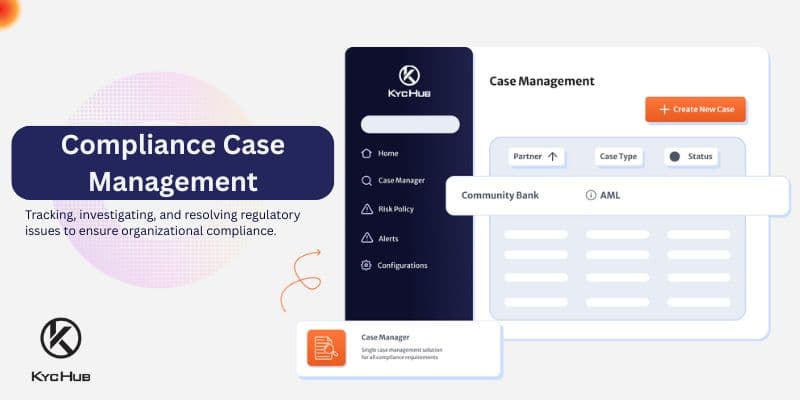
Manual processes are error-prone, and those errors turn into regulatory breaches, financial penalties, and reputational damage. KYC Hub's Compliance Workflow Automation is built to take that risk off the table. It leads with a few capabilities that matter most to a fintech compliance team.
- No-Code Customization: Build and change workflows without writing code, either from scratch or from a library of pre-configured templates, and adapt them as your requirements shift.
- Dynamic Customer Risk Assessment: A risk engine applies custom conditions and customer segmentation so risk profiles adjust in real time as behavior and circumstances change.
- Integrate with Verification Services: The platform connects with global verification providers and the services you already run, so AML screening and monitoring and identity checks slot into one flow.
- Automated Decisioning: An AI-based decision engine clears low-risk customers automatically and defines exactly when a case should be handed to a person.
- Managed Services: Compliance support spanning onboarding, verification, and ongoing customer monitoring, for teams that want extra hands on the operational load.
Beyond those pillars, the solution does a lot of quiet operational work. Cases get assigned to the right role automatically. Workflow progress is tracked in real time so bottlenecks surface early, and a full audit trail of historical activity stays ready for examiners. Role-based access controls limit sensitive data to authorized staff. The reporting layer then turns workflow data into the insight a compliance lead uses to tighten the program. The aim is straightforward. Less manual labor, fewer errors, and time and cost savings a lean team can feel.
Book a Workflow Automation Demo
The Future of Compliance Automation for Fintech
Where this goes next is shaped almost entirely by technology and by the regulation chasing it. As fintechs keep reinventing financial services, their compliance has to evolve in step or fall behind the rules it is meant to satisfy.
The near term is already busy. In Europe, lawmakers reached political agreement on PSD3 and a new Payment Services Regulation in late 2025, and the agreed texts were published in April 2026, with publication in the Official Journal expected around mid-year and the rules generally applying roughly twenty-one months after that. The scope widens considerably. It reaches instant payments now. It reaches buy-now-pay-later, crypto, and digital identity. On the AML side, the EU's new Anti-Money Laundering Authority became operational in mid-2025 and is taking on its AML and counter-financing-of-terrorism mandates, while the single-rulebook AML Regulation applies from 10 July 2027. The practical lesson for a buyer is one line long. Whatever you adopt has to be maintained through these transitions, not frozen against today's rulebook.
Automated platforms such as the ones KYC Hub builds help fintechs keep up with that churn. They take on risk assessment. They handle regulatory reporting and vendor risk management too, so the work stays consistent and accurate as the rules move. Artificial intelligence pushes this further still. Real-time analytics and actionable intelligence let a compliance team see risk coming rather than reacting after the fact, which is roughly where the whole field is headed.