Face ID Check: How It Stops Identity Theft in Customer Onboarding
A face id check is a biometric control. It matches a person's live face against a trusted reference and proves that face belongs to a real, present human, confirming the applicant is genuinely who they claim to be. For regulated businesses, the check lives inside the onboarding flow, where it guards against synthetic identities, account takeover, and stolen credentials. Add liveness detection on top and it shuts out the photos, replays, and deepfakes that slip past basic visual checks.
As more onboarding and transactions move online, identity theft keeps growing alongside them. Fraudsters use stolen documents and personal data to open accounts, apply for credit, and launder funds. Below, we cover what a face id check is, how it works in a compliance context, the attacks it has to withstand, and how to deploy it so it actually cuts fraud instead of just adding friction.
What Is a Face ID Check?
A face id check verifies a person through facial recognition. It reads the distinctive geometry of a face, weighs it against a reference image, and confirms that the genuine identity owner is the one requesting access or being onboarded. The technique shows up across banking, payments, e-commerce, and government, where it holds the line on security while resisting impersonation.
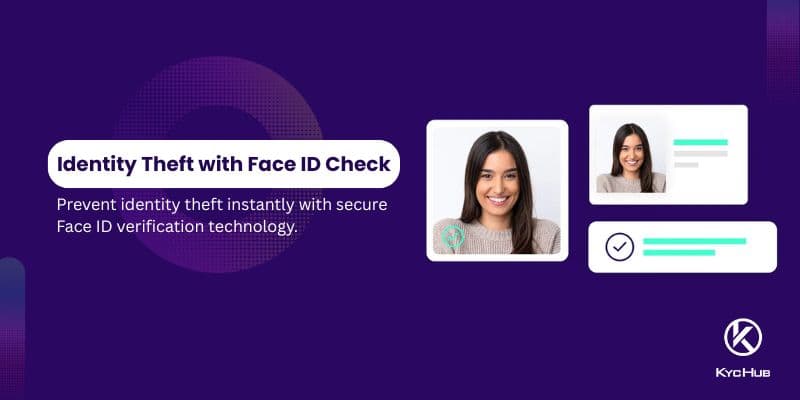
In a business and compliance setting, the term covers two related operations. The first is selfie-to-document matching: a live capture of the customer is compared against the photo on a submitted ID. The second is verification against a previously enrolled face, used to re-authenticate a returning user. Either way, liveness detection does the work of confirming the face is live, not a printout, a screen, or an AI-generated render.
How Does a Face ID Check Work?
A face id check captures a high-resolution image of a face and maps its unique features with machine learning. Four stages make up the typical flow:
- Face capture: A detailed image is acquired through a device or mobile camera under quality and lighting checks.
- Feature analysis. Distinct facial landmarks, including eye spacing, nose structure, and jawline, get measured and turned into a mathematical template.
- Data matching: The captured template is compared against a reference, either the photo on an identity document or a stored enrollment, and a match score is returned.
- Liveness detection confirms a live person is present and blocks spoofing attempts that use photos, videos, or masks.
For a compliance team, the output is more than a yes or no. A well-designed check hands back a confidence score, a liveness result, and an audit record. Analysts can then review borderline cases and show due diligence to regulators.
Face ID Check vs. Document Verification
Document verification and face id checks solve different parts of the same problem, and strong onboarding uses both. Document verification confirms an identity document is authentic and unaltered. A face id check confirms the person submitting that document is the rightful holder and is physically present. Skip the face check, and a fraudster holding a stolen or purchased genuine document can clear document checks alone.
Combining the two closes the gap. The document establishes who the identity belongs to, and the biometric identity verification step binds the live applicant to that identity. That pairing is what stops a clean document from being weaponized by someone other than its owner.
Identity Theft Risks a Face ID Check Must Defend Against
A face id check is only as strong as its resistance to attack. Compliance teams evaluating a vendor should understand the threats the system has to withstand. A check with weak liveness gives nothing but a false sense of security.
Spoofing and 3D Mask Attacks
The most direct attack is presentation spoofing. Here a fraudster holds a high-resolution photo, a video replay, or a 3D-printed mask up to the camera to pose as a legitimate user. Systems that look only for a matching face, with no depth or motion analysis, fall for it. Strong face liveness detection counters it by telling a live human apart from any static or replayed artifact.
Account Takeover and Fraudulent Transactions
Defeat a face check, and an attacker can take over an account and authorize transactions in the victim's name. Biometrics raise a problem all their own here. You can reset a password, but no one can reset a compromised face. That permanence is exactly why the liveness and anti-spoofing layers matter, and why a biometric result should count as one signal within a broader fraud prevention strategy rather than a single point of failure.
Data Breaches and Biometric Data Leakage
Facial recognition relies on stored biometric templates, and a breach of that store hits hard because the data cannot be reissued. Leaked facial data fuels identity theft and ends up traded on illicit markets. For any business holding biometric records, that makes encryption, strict access controls, and careful data residency decisions non-negotiable.
Deepfake Technology and AI Manipulation
Deepfakes use artificial intelligence to generate lifelike video that can be injected into a verification flow to beat facial recognition. As generative tools grow more accessible, injection and deepfake attacks against onboarding are climbing. A face id check has to keep improving in response, combining passive liveness, injection-attack detection, and ongoing model updates to stay ahead.
How to Deploy a Face ID Check That Reduces Fraud
Buying a face check is not the same as reducing fraud. The control has to live inside a layered process. These measures separate an effective program from a checkbox one.
Multi-factor authentication. Combine the face id check with passwords, one-time passcodes, or device signals so that defeating one factor does not grant access.
Real-time verification. Run the check right at onboarding or at a high-risk transaction, then pass anomalies into monitoring instead of treating the result as final.
Secure, encrypted storage. Encrypt biometric templates and restrict access, so a breach does not expose reusable facial data.
AI-driven risk scoring flags suspicious sessions, repeated face reuse, or anomalous device behavior before any of it escalates into fraud.
Regular audits and oversight. Reassess thresholds, false-accept and false-reject rates, and bias across demographics on a recurring schedule, and document the results for examiners.
Where Face ID Checks Are Used in Regulated Industries
One control adapts across sectors with very different risk profiles. In banking and payments, a face id check binds a new account to a real applicant and re-authenticates high-value transactions. Healthcare uses it for accurate patient identification and to restrict access to sensitive areas, though it raises clear obligations around storing biometric data. Airports and border control, such as the U.S. Customs and Border Protection program, run facial recognition to verify travelers and speed processing while drawing scrutiny over surveillance and data handling.
Across all of these, the compliance lesson stays the same. The benefit is real, yet it carries privacy, consent, and data-protection duties under regimes like GDPR and CCPA. A deployment you can defend stays transparent about what is collected, why, and how long it is retained.
KYC Hub Face Liveness and Biometric Verification
KYC Hub takes on identity theft at onboarding through face liveness and biometric verification built for regulated businesses. The product leads with passive liveness detection that confirms a real, present person without putting the user through awkward gestures, so onboarding stays smooth while spoofs get blocked. Resistance to deepfakes and presentation attacks is built in, so injected video, replays, and masks get caught rather than waved through.
Selfie-to-ID matching binds the live applicant to the identity document and closes the gap that document checks alone leave open. Because the biometric check is just one layer in a wider workflow, its results feed risk scoring and ongoing fraud prevention rather than standing alone. Encryption and access controls guard the biometric data, so the verification process does not turn into the next breach.
Photos and screen replays fool basic face checks. KYC Hub's face liveness detection confirms a real, present person and produces the audit trail your examiners expect.