Combating Financial Crime in 2026: A Compliance Playbook
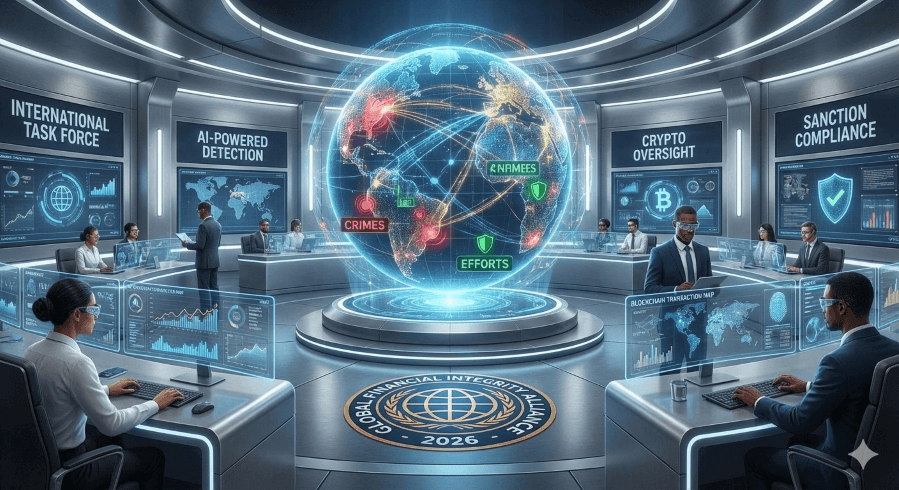
Combating financial crime is the coordinated work of detecting, preventing, and reporting money laundering, terrorist financing, fraud, and sanctions evasion across the financial system. In practice that means a compliance program that screens customers and counterparties, watches transactions in real time, and files timely reports to regulators and financial intelligence units. For a B2B compliance team, the job comes down to disrupting illicit flows before they settle, and keeping false positives low enough that analysts can spend their hours on genuine risk.
What follows is a look at how that fight is structured in 2026: the global standard-setters, the national regulators and enforcement bodies, the role of financial intelligence units, public-private collaboration, and the technology that ties it together.
What Is Financial Crime?
Financial crime is any non-violent offense that produces, moves, or conceals illicit value through the financial system. Compliance teams typically manage six core categories: money laundering, terrorist financing, fraud, bribery and corruption, sanctions evasion, and market abuse. These offenses rarely sit in isolation. Fraud generates proceeds that someone then has to launder, and a sanctions breach often leans on the same opaque ownership structures that enable corruption.
For regulated firms, the practical definition is narrower and more demanding. Here, financial crime is the set of risks you are legally obligated to identify, mitigate, and report. That obligation flows from anti-money laundering and counter-terrorist-financing laws, and it turns abstract criminal activity into concrete controls: customer due diligence, AML screening and monitoring, and suspicious activity reporting.
The Global Standards Behind Combating Financial Crime
Illicit funds move across borders by design, so no single country can address financial crime alone. A handful of international bodies set the standards that national regimes then implement.
Financial Action Task Force (FATF)
The FATF is the intergovernmental body that sets the global benchmark for fighting money laundering and terrorist financing. Established in 1989, it now comprises 39 members. Most national AML regimes are built on its 40 Recommendations, which cover customer due diligence, risk assessment, beneficial ownership, and suspicious transaction reporting.
Beyond the standards themselves, the FATF runs mutual evaluations that test how well each jurisdiction applies them, and it publishes typologies reports documenting emerging laundering and terrorist-financing methods. A jurisdiction that shows strategic deficiencies can land on one of the FATF's public lists. That raises the cost of doing business there and pushes reform.
INTERPOL
INTERPOL connects police forces across 196 member countries to investigate and disrupt crime, including cross-border financial crime. It lets law enforcement share intelligence on economic offenses and backs member countries with specialized investigative assistance, training, and operational coordination. Why does INTERPOL matter to compliance teams? Its notices and data feed the broader ecosystem of watchlists and law-enforcement cooperation that screening leans on.
United Nations Office on Drugs and Crime (UNODC)
The UNODC works to strengthen national capacity against organized crime, illicit drugs, and money laundering. It supports the United Nations Convention against Corruption and runs the Global Programme against Money-Laundering, which provides training and technical assistance so countries can build effective AML and counter-financing-of-terrorism systems.
Financial Crime Compliance: Regulators and Enforcement
Global standards only bite when national regulators enforce them. Financial crime compliance is the operational layer: where firms turn AML and CTF law into working controls, and where supervisors hold them to account.
The Financial Crimes Enforcement Network (FinCEN)
In the United States, the Financial Crimes Enforcement Network administers the Bank Secrecy Act and the country's core AML rules. Working alongside federal and local law enforcement, FinCEN holds banks and other financial institutions to their reporting and recordkeeping obligations. Failure to comply can bring heavy penalties, and where violations persist, responsible individuals can be on the hook as well.
The Financial Conduct Authority and AMLD
In the United Kingdom, the Financial Conduct Authority (FCA) supervises firms for AML and CTF compliance and can fine or otherwise sanction those that fall short. Across the European Union, the Anti-Money Laundering Directives require member states to maintain beneficial-ownership registers and to apply customer due diligence before accounts are opened. Between them, these regimes give the FATF Recommendations legal force at the regional and national level.
Book an AML Screening Demo to see how KYC Hub maps screening and monitoring controls to these obligations.
Financial Intelligence Units and Reporting
Financial intelligence units (FIUs) are the national bodies that collect, analyze, and disseminate reports on suspicious financial activity. When a regulated firm files a suspicious activity report, the FIU is usually where it lands. The unit then enriches the report, connects it with other intelligence, and routes actionable cases on to law enforcement.
Laundering networks rarely stay within one jurisdiction, so cross-border sharing between FIUs is essential. The Egmont Group connects FIUs worldwide, letting intelligence on a single network be assembled from every country it touches. Report quality matters for exactly this reason. A vague or late filing weakens the whole chain, while a precise one can seed an international investigation.
How to Report Financial Crime
For a regulated business, reporting financial crime is a defined process, not a judgment call. The controls that trigger a report usually run in this order:
- Detect. Transaction monitoring or screening alerts surface the activity, or a frontline colleague escalates it.
- Investigate the alert, document the analysis, and decide whether a reasonable suspicion exists.
- File. Submit a suspicious activity report, or your jurisdiction's equivalent, to the relevant FIU within the required timeframe.
- Preserve records and avoid tipping off the subject, then keep monitoring the relationship for further activity.
How useful these reports turn out to be rests heavily on the underlying data. Strong transaction monitoring and well-tuned screening cut the noise, so analysts spend their time on the cases that actually warrant a filing.
Financial Crime Risk Assessment
No defensible program stands without a financial crime risk assessment underneath it. It maps where the business is exposed across customers, products, geographies, channels, and counterparties, then ranks those exposures so that controls and analyst attention land on the highest risk first.
A risk assessment is never a one-time document. Products launch, the firm enters new markets, criminal methods evolve, and the risk picture shifts with them, so the controls have to follow. Regulators expect to see a current, evidence-based version above all, because it explains why your customer due diligence, screening thresholds, and monitoring rules are calibrated the way they are.
Public-Private Cooperation Against Financial Crime
Some of the sharpest work against financial crime happens where banks, regulators, and law enforcement share intelligence directly with one another. Partnerships like these cut duplication and let each side see patterns the others cannot.
Take the Joint Money Laundering Intelligence Taskforce (JMLIT) in the United Kingdom. Operating since 2015, it has acted as a bridge between financial institutions and law enforcement, supporting a more coordinated response to laundering networks. In the United States, FinCEN's public-private information-sharing channels feed Bank Secrecy Act reporting to law enforcement partners, including the FBI, to generate leads and advance investigations into criminal networks. The common thread: pairing private-sector transaction visibility with public-sector investigative reach surfaces threats that neither could find alone.
Using Technology and AI to Detect Financial Crime
Manual review cannot keep up with the scale of modern payments, so technology now sits at the center of combating financial crime. Automated screening checks customers and counterparties against sanctions, politically exposed person, and adverse-media data. Transaction monitoring runs alongside it, evaluating activity in real time against risk rules.
Machine learning adds another layer. It catches anomalies and patterns that static rules and human reviewers tend to miss, and it helps triage alerts so analysts focus on the highest-risk cases. The point is not to replace judgment but to direct it. When detection improves and false positives drop, decisions get faster and easier to defend. For a deeper view of where the field is heading, see KYC Hub's overview of the latest compliance and AML trends.
How KYC Hub Helps Compliance Teams Combat Financial Crime
KYC Hub provides an end-to-end AML screening and ongoing monitoring solution built for the realities above. The platform leads with exhaustive AML screening across sanctions, PEP, and watchlist data, backed by continuous monitoring and AML alerts so that risk changes get caught after onboarding, not only at it.
Global adverse media intelligence surfaces negative news that traditional lists miss. Network intelligence goes further, exposing the hidden relationships behind shell structures and layered ownership. Broad global data coverage supports cross-border programs, and the system is tuned to throw fewer false positives so analyst time goes to genuine risk. What you get is a screening and monitoring layer that maps directly to FATF-aligned obligations, FIU reporting, and a risk-based program.
If your team is burning too many hours clearing alerts that go nowhere, see what end-to-end screening and monitoring looks like on live cases. Book an AML Screening Demo.